
Islamic Qurbani Rules You Must Know Before Eid Day
Table of Contents
Eid al-Adha is not associated with a single individual, nation, or people. Rather, it is a global occasion experienced by more than one billion Muslims who turn toward one Qiblah, recite the same Takbeer, and perform the ritual of sacrifice during these blessed days. One of the most important rituals of Eid al-Adha is the Qurban, which is governed by specific islamic qurbani rules.
Qurban (Udhiya) is not simply the act of slaughtering an animal. It is an act of worship through which we revive the memory of the great story of sacrifice, when Prophet Ibrahim عليه السلام completely submitted to the command of Allah and prepared to carry out the sacrifice without hesitation, while Prophet Ismail عليه السلام accepted the command without objection, and then the ransom came down from heaven.
What are the islamic qurbani (Udhiya) rules? What are the conditions of a valid sacrifice? how to distribute the meat properly, lets explore the answers with the common mistakes that should be avoided.
Start your tailored Islamic learning with a free consultation from Al-Azhar-certified Sheikhs in Egypt.
Islamic Qurbani Rules You Must Know Before Eid
The Islamic Qurbani Rules include two main aspects: the first relates to the Muslim who will perform the sacrifice, and the second concerns the conditions that must be fulfilled by the animal being sacrificed.The conditions related to the person offering the sacrifice include:
- The animal must be fully owned by him and not connected to the rights of others
Therefore, it is not valid to offer as Qurban (Udhiya) an animal that is mortgaged or unlawfully possessed.
- The sacrifice must also be performed with the intention of Qurban and within the time specified by Islamic law,
which begins after the Eid prayer on the Day of Sacrifice (10th Dhul Hijjah) and continues until sunset on the last of the Days of Tashreeq, the 13th of Dhul Hijjah. Whoever slaughters before the Eid prayer is completed, or after sunset on the 13th day, his Qurban is not considered valid. Allah says:
“So pray to your Lord and sacrifice.” (Surah Al-Kawthar: 2)
- Another Islamic Qurbani Rules for the person intending to offer Qurban is
that once the month of Dhul Hijjah begins, it is prohibited for him to remove any hair from his body, cut his nails, or remove anything from his skin until the sacrifice is performed. However, he is not prohibited from wearing new clothes, applying henna or perfume, or being intimate with his wife, including marital relations.
This ruling applies only to the person offering the sacrifice and not to the rest of his household. The same ruling also applies to women: if a woman intends to offer Qurban (Udhiya) on her own behalf, whether she is married or unmarried, she should refrain from removing any body hair or cutting her nails until her sacrifice is completed.
Who Must Perform Qurban and Who Doesn’t
Qurban (Udhiya) is a highly emphasized Sunnah for those who are financially able to afford it, based on the statement of the Prophet ﷺ: “Whoever has the means and does not offer a sacrifice, let him not approach our place of prayer.”
The apparent meaning of this hadith suggests obligation. However, other narrations indicate that it is a confirmed Sunnah rather than an absolute obligation. Among them is the narration that the Prophet ﷺ – after eid prayer– sacrificed two rams, one on behalf of himself and the other on behalf of those among his Ummah who did not offer a sacrifice. Another evidence is his statement ﷺ:
“Whoever among you intends to offer a sacrifice should not remove anything from his hair or nails.”
This indicates that Qurban is a highly recommended Sunnah. So, a Muslim is expected to perform Qurban if he or she:
- Is an adult
- Is sane
- Possesses enough wealth beyond basic necessities
- Can afford the sacrifice without hardship
Among the important islamic qurbani rules is that one Qurban may represent an entire household. For example, a father may offer one sheep on behalf of himself and his family members living with him.
Conditions for a Valid Sacrifice
The Islamic Qurbani Rules according to the sacrifice are several conditions :
The first condition is that the sacrifice must be from livestock animals, which include camels, cattle, and sheep of both types: lambs and goats. Allah the Almighty says:
“And for every nation We have appointed a rite of sacrifice that they may mention the name of Allah over the livestock He has provided for them.” [Surah Al-Hajj: 34]
The second condition is that the animal must reach the age recognized in Islamic law:
- Camels: at least five years old
- Cattle: at least two years old
- Goats: at least one year old
- Sheep: at least six months old
The third condition is that the animal must be free from defects that prevent the sacrifice from being valid. Four defects were mentioned in the hadith of the Messenger of Allah ﷺ, who said:
“Four animals are not permissible for sacrifice: the one-eyed animal whose defect is obvious, the sick animal whose sickness is obvious, the lame animal whose limp is obvious, and the extremely weak animal that has no marrow in its bones.”
The defects mentioned in the hadith also include similar conditions such as:
- Clear blindness or severe eye damage, including total blindness in both eyes.
- Obvious illness whose symptoms appear clearly on the animal, such as fever, mange, or deep wounds affecting its health.
- Severe lameness that prevents normal walking, including an animal missing a leg or foot.
- An overfed animal that has eaten beyond its capacity until it becomes seriously bloated and remains in danger.
- An emaciated animal that has become extremely thin and weak to the point that its marrow has wasted away.
Islam teaches mercy toward animals even during slaughter. The knife should be sharp, the animal should not be harmed unnecessarily, and the slaughter should be carried out quickly and compassionately. The Prophet ﷺ instructed Muslims to show excellence in every matter, including slaughtering animals.
How to Divide the Meat Correctly
One of the beautiful aspects of Qurban is sharing food with others. Eid al-Adha is not meant to be a private celebration for wealthy families alone. Rather, it is a time when the poor and needy also experience joy and dignity.
It is recommended for the person offering Qurban (Udhiya) to eat from his sacrifice, give some of it as gifts to relatives, and donate some to the poor. The Messenger of Allah ﷺ said:
“Eat from it, feed others, and store some of it.”
Scholars have stated that the preferred distribution is
- One-third for the household
- One-third for relatives and friends
- One-third for the poor and needy
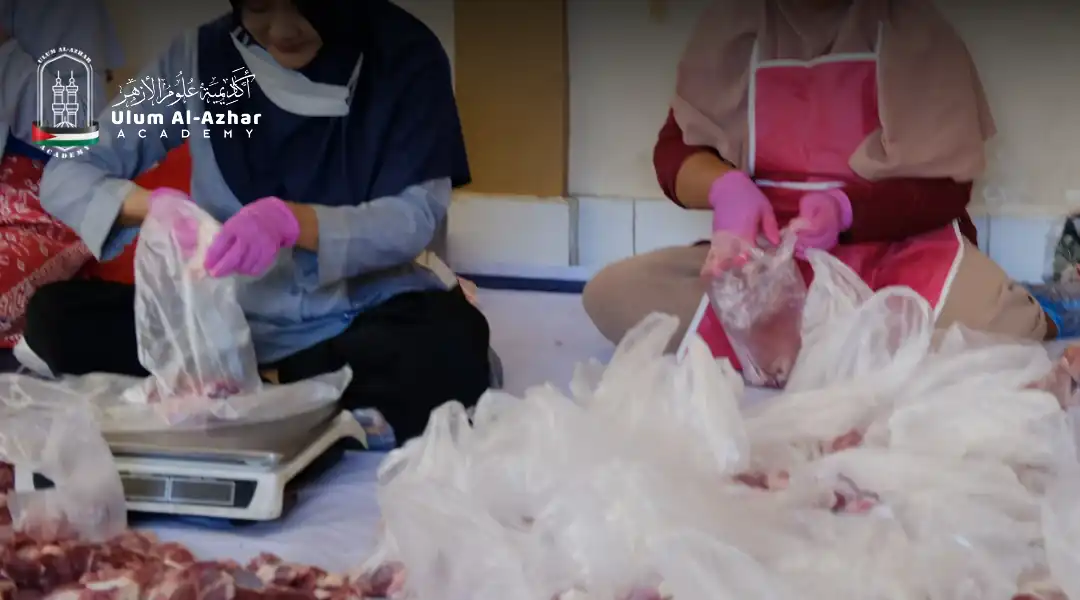
Among the valuable islamic qurbani rules: It is also permissible to transfer the meat, even to another country if needed. However, it is not permissible to sell any part of the sacrifice, including its skin.
The sharia law emphasizes that the butcher should not be given any portion of the meat as payment for his work, although the person offering the sacrifice may voluntarily gift him some of it afterward. Instead, the meat should be given in charity or used in beneficial ways by the owner of the Qurban.
Among the Sunnahs of Qurban
It is recommended for the Muslim who is skilled in slaughtering to slaughter his Qurban with his own hand and to say: “Bismillah, Allahu Akbar. O Allah, this is on behalf of so-and-so,”
mentioning his own name. It is narrated that the Messenger of Allah ﷺ slaughtered a ram and said:
“Bismillah, Allahu Akbar. O Allah, this is on behalf of me and those of my Ummah who did not offer a sacrifice.”
If a Muslim is not skilled in slaughtering, then it is recommended for him to attend and witness the sacrifice. The Prophet ﷺ said to Fatimah رضي الله عنها:
“O Fatimah, stand and witness your sacrifice, for with the first drop of its blood, every sin you have committed will be forgiven.” One of the companions asked:“O Messenger of Allah, is this only for you and your family, or for all Muslims?” The Messenger of Allah ﷺ replied: “Rather, it is for all Muslims.”
The Prophet ﷺ also had a special practice on Eid al-Adha: he would not eat before returning from the prayer ground, and then he would eat from his sacrifice. It was narrated by Buraidah رضي الله عنه:
“The Messenger of Allah ﷺ would not go out on the day of Eid al-Fitr until he had eaten, and he would not eat on the day of Eid al-Adha until he returned and ate from his sacrifice.”
Know Your Prophet (Attributes & Seerah of Prophet Muhammad PBUH) through Seerah of Prophet Muhammad: Get to know our role model: Prophet Muhammad by studying his life, character, attributes, and teaching style.
Conclusion
A believer takes advantage of the days of Eid by visiting relatives, family members, neighbors, and friends, seeking thereby the pleasure of Allah the Almighty. It was narrated from Anas رضي الله عنه that the Messenger of Allah ﷺ said:
“Whoever wishes for his provision to be increased and his life to be blessed, let him maintain the ties of kinship.”
During these blessed days, the Muslim also follows the tradition of Prophet Ibrahim and our Prophet Muhammad ﷺ by observing the proper conditions and islamic qurbani rules.
Access a free consultation with Al-Azhar-certified Sheikhs from Egypt to begin your personalized Islamic education.
FAQs
What are the main islamic qurbani rules?
Offering the sacrifice after Eid prayer, choosing a healthy eligible animal, mentioning the name of Allah during slaughter, and distributing meat properly.
Is Qurban obligatory for every Muslim?
Qurban is required for financially capable Muslims according to some scholars, while others consider it a highly emphasized Sunnah.
Can one Qurban count for an entire family?
Yes. One sheep or goat may count for one person and the members of his household.
What happens if the animal is slaughtered before Eid prayer?
It does not count as Qurban and is considered an ordinary meat charity instead.
Can Several People Share One Qurban?
Yes, if the sacrifice is a camel or a cow. A cow or camel is sufficient for up to seven people, meaning that each person’s share must not be less than one-seventh.
