
Step by Step Prayer in Islam for Beginners
Table of Contents
All of a believer’s affairs are in the Hands of Allah, and whenever he desires something, he should turn to Allah alone. Therefore, Allah has blessed us with the five daily prayers so that we may remain constantly connected to our Creator. Therefore, every Muslim seeks to learn step by step prayer in islam.
A believer should glorify his Lord, recognize His greatness, and realize that he is a weak servant with no power or strength of his own. He stands in prayer before the Creator, in whose Hands belong all power and might. He should firmly believe that prayer is a magnificent divine gift from the Creator to His creation — through it, the heart is renewed, determination is strengthened, and the soul is purified. Therefore, one should approach prayer in a manner that pleases Allah, while seeking the help of Allah Almighty against his own desires, weaknesses, and Satan.
This guide explains the step by step prayer in islam in a simple and organized way so that beginners can learn how to perform Salah correctly and confidently. Along with the physical actions, it is also important to understand the meanings and supplications recited during prayer.
Engage in a free consultation with Al-Azhar-certified Sheikhs from Egypt to tailor your Islamic learning experience.
Step by Step Prayer in Islam for Beginners
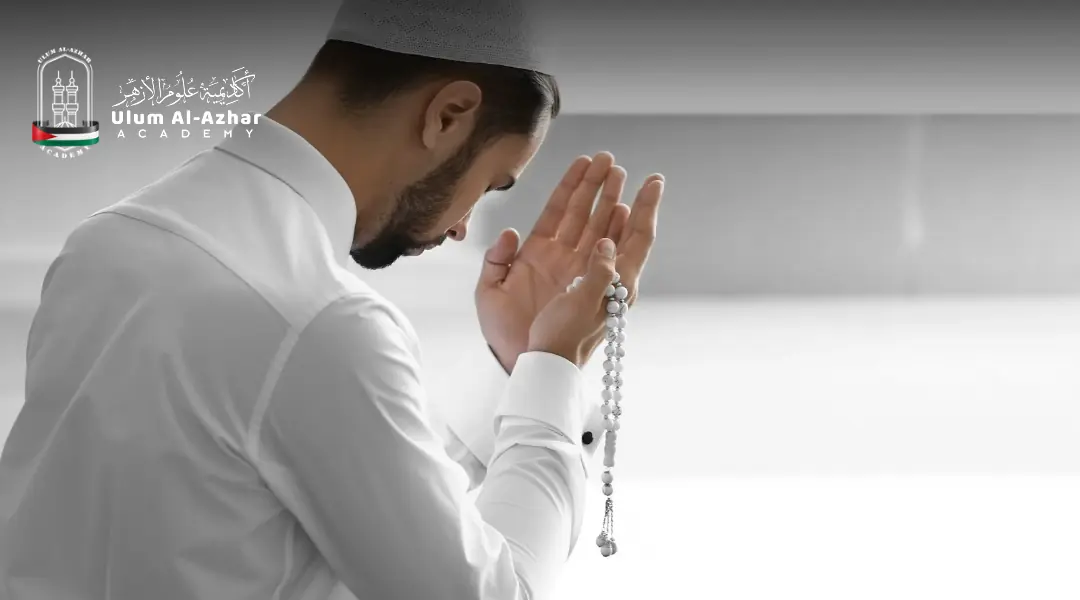
The Prophet Muhammad ﷺ said: “Pray as you have seen me praying.” —The description of the step by step prayer in islam as mentioned in the Sunnah is as follows:
- He performs wudu thoroughly, meaning that he performs ablution as Allah has commanded us.
- The worshipper stands facing the Qiblah with intention in his heart and says Takbiratul Ihram, “Allahu Akbar” (Allah is the Greatest), while raising both hands to the level of the shoulders or the ears, and keeps his gaze directed toward the place of prostration.
- Then, he places his right hand over his left hand, positioning them on his chest, above the navel below the chest, or below the navel.
- Then he recites the opening supplication which is sunnah:
“Subhanaka Allahumma wa bihamdika wa tabaraka ismuka wa ta‘ala jadduka wa la ilaha ghayruk”
(Glory be to You, O Allah, and praise be to You. Blessed is Your Name, exalted is Your Majesty, and there is no deity besides You), - Then he says: “A‘udhu billahi min ash-shaytan ir-rajim” (I seek refuge in Allah from the accursed Satan), “Bismillah ir-Rahman ir-Rahim” (In the Name of Allah, the Most Merciful, the Most Compassionate), then he recites Surah Al-Fatihah, and at its end he says “Ameen” aloud in audible prayers and silently in quiet prayers.
- Then, after Al-Fatihah in the first two rak‘ahs, he recites whatever is easy for him from the Quran.
- Then he says the takbir for bowing, raising his hands to the level of his shoulders or ears, then places his hands on his knees with his fingers spread apart. He keeps his head level with his back, straightens and extends his back, remains calm in his bowing, and says: “Subhana Rabbiyal-‘Azim” (Glory be to my Lord, the Most Great) three times or more.
- Then he raises his head saying: “Sami‘a Allahu liman hamidah” (Allah hears the one who praises Him), while raising his hands. Saying “Sami‘a Allahu liman hamidah” is for the imam or one praying alone, but not for the follower in the congregation.
- When he stands upright, he says: “Rabbana wa lakal hamd,” or “Rabbana lakal hamd,” or “Allahumma Rabbana wa lakal hamd,” or “Allahumma Rabbana lakal hamd.”
- Then he says the takbir without raising his hands and goes down into prostration, prostrating on the seven body parts [the forehead and nose, the two hands, the two knees, and the tips of the feet]. He places his hands level with his shoulders or ears, lifts his forearms off the ground, and says in his prostration: “Subhana Rabbiyal-A‘la” (Glory be to my Lord, the Most High) three times or more. He also increases in supplication, because the Prophet ﷺ said:
“The closest a servant comes to his Lord is while he is prostrating, so increase your supplications.” — Narrated by Sahih Muslim.
- Then he raises himself saying the takbir, sits down, and places his right hand on his right thigh and his left hand on his left thigh near the knee, or on the knee. He remains calm in his sitting and says: “Rabbi ighfir li” (My Lord, forgive me) three times or more.
- Then he says the takbir and prostrates, doing in the second prostration as he did in the first.
- Then he raises his head saying the takbir and stands up for the second rak‘ah, doing in the second rak‘ah as he did in the first rak‘ah, including the recitation of Surah Al-Fatihah and a short surah, bowing, and prostration.
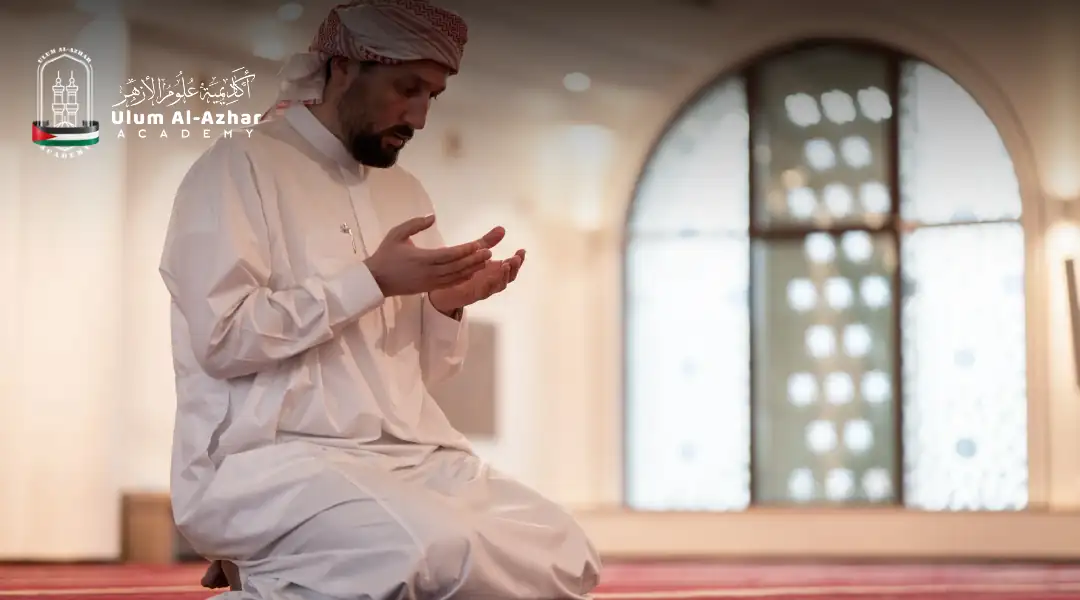
- According to step by step prayer in islam, after the two prostrations of the second rak‘ah, he sits for the Tashahhud in the iftirash position, which means that he lays his left foot flat and sits on it, while keeping the right foot upright. He places his hands on his thighs, closes all his fingers, points with the index finger, and looks at it. In the three- and four-rak‘ah prayers, he recites the first part of the Tashahhud:
- “At-tahiyyatu lillahi was-salawatu wat-tayyibat. As-salamu ‘alayka ayyuhan-nabiyyu wa rahmatullahi wa barakatuh. As-salamu ‘alayna wa ‘ala ‘ibadillahis-salihin. Ashhadu an la ilaha illa Allah, wa ashhadu anna Muhammadan ‘abduhu wa rasuluh.”In the two-rak‘ah prayer, he recites the complete Tashahhud.
- Then he stands up saying the takbir for the third rak‘ah while raising his hands, and prays the third and fourth rak‘ahs, reciting Surah Al-Fatihah.
- Then he sits for the final Tashahhud in the tawarruk position. Its description is that he lays his left foot flat and brings it out from his right side, keeps his right foot upright, and sits on his seat. Then he recites the final Tashahhud, which is the first Tashahhud with the addition of:“Allahumma salli ‘ala Muhammad wa ‘ala ali Muhammad kama sallayta ‘ala Ibrahim wa ‘ala ali Ibrahim innaka Hamidun Majid. Allahumma barik ‘ala Muhammad wa ‘ala ali Muhammad kama barakta ‘ala Ibrahim wa ‘ala ali Ibrahim innaka Hamidun Majid.”(O Allah, send prayers upon Muhammad and upon the family of Muhammad as You sent prayers upon Ibrahim and upon the family of Ibrahim. Indeed, You are Praiseworthy, Glorious. O Allah, bless Muhammad and the family of Muhammad as You blessed Ibrahim and the family of Ibrahim. Indeed, You are Praiseworthy, Glorious.)
- He then seeks refuge with Allah from four things, saying: “Allahumma inni a‘udhu bika min ‘adhabi Jahannam, wa min ‘adhabil-qabr, wa min fitnatil-mahya wal-mamat, wa min sharri fitnatil-Masihid-Dajjal.”(O Allah, I seek refuge in You from the punishment of Hellfire, from the punishment of the grave, from the trials of life and death, and from the evil trial of the False Messiah.)Then he supplicates with whatever he wishes.
- Then he gives salam to his right and left, saying: “As-salamu ‘alaykum wa rahmatullah… As-salamu ‘alaykum wa rahmatullah.” (Peace and the mercy of Allah be upon you.)
- After completing the prayer, he says:
- “Astaghfirullah” (I seek Allah’s forgiveness) three times, and says:
- “Allahumma anta as-salam wa minka as-salam tabarakta ya dhal-jalali wal-ikram.”
- “La ilaha illa Allah wahdahu la sharika lah, lahul-mulku wa lahul-hamd, yuhyi wa yumit, wa huwa hayyun la yamut, biyadihil-khayr, wa huwa ‘ala kulli shay’in qadir.”
- Ayat al-Kursi
Learning the step by step prayer in islam becomes easier through consistent practice. Beginners should focus on understanding one step at a time rather than trying to perfect everything immediately.
What to Say in Each Position of Salah
Knowing the words recited in each position of the prayer makes it easier for you to follow the steps of Salah. In the step by step prayer in islam, every position has specific words connected to it. Here is a compiled list of these words:
| During Standing | Surah Al-Fatihah is recited (followed by another Quranic passage in the first and second raka’h) |
| During Bowing (Ruku) | Subhana Rabbiyal ‘Azim (3 times) |
| while Standing After Ruku | “Sami‘ Allahu liman hamidah” then Rabbana wa lakal hamd |
| During Prostration (Sujud) | Subhana Rabbiyal A‘la” (3 times) |
| Between the Two Prostrations | Rabbi ighfir li wa-irhamni wa-ihdini wa-irzoqni |
| After the prostration of the second rak‘ah and the prostration of the fourth rak‘ah. | Tashahhud |
Conditions for a Valid Prayer
Prayer has conditions, pillars, obligations, and Sunnahs. According to the step by step prayer in islam guide the difference between them is as follows:
- Conditions of Prayer (fulfilled before the prayer begins): These are matters upon which the validity of the prayer depends. If a person leaves out any of them, the prayer becomes invalid.
- Pillars of Prayer (fulfilled within the prayer itself) : If any one of them is omitted — whether intentionally, forgetfully, or out of ignorance — the prayer becomes invalid. If the worshipper leaves it out due to forgetfulness or absentmindedness and then remembers it, he must perform it and make the prostration of forgetfulness (Sujood As-Sahw).
- Obligatory Acts of Prayer: If they are intentionally omitted, the prayer becomes invalid. If they are omitted out of forgetfulness or ignorance, they are waived and compensated for by the prostration of forgetfulness (Sujood As-Sahw).
- Sunnahs of Prayer: If a person performs them, they receive great reward and virtue. If they do not perform them, they have left a Sunnah, but there is no sin upon them.
The Conditions for the Validity of Prayer Are Nine:
- Islam – Prayer is not valid from a disbeliever.
- Sanity – Prayer is not valid from an insane person.
- Discernment – This is attained at the age of seven years.
- Purification when able – One must be in a state of purity if capable.
- The entrance of the prayer time – Prayer is not valid before its prescribed time begins.
- Covering the awrah – The required parts of the body must be covered.
- Avoiding impurities – One must avoid physical impurities on the body, clothing, and place of prayer. And removing major ritual impurity through ghusl and minor ritual impurity through wudu.
- Facing the Qiblah – One must face the direction of the Kaaba.
- Intention (Niyyah) – The intention for the prayer must be made.
The Pillars of Prayer Are Fourteen:
- Standing in obligatory prayer for the one who is able.
- The opening takbir (Takbirat Al-Ihram).
- Reciting Surah Al-Fatihah completely and in order in every rak‘ah.
- Bowing (Ruku).
- Rising from bowing.
- Standing upright after bowing.
- Prostration (Sujud).
- Rising from prostration.
- Sitting between the two prostrations.
- Tranquility in all pillars of the prayer.
- The final Tashahhud.
- Sitting for the final Tashahhud.
- The two taslims (ending salutations).
- Performing the pillars in the proper order as mentioned.
The Obligatory Acts of Prayer Are Eight:
- The takbirs other than Takbirat Al-Ihram, which are the takbirs of movement.
- Saying “Sami‘a Allahu liman hamidah”
- Saying “Rabbana wa lakal hamd” for the imam, follower, and person praying alone.
- Saying “Subhana Rabbiyal-‘Azim” during bowing.
- Saying “Subhana Rabbiyal-A‘la” during prostration.
- Saying “Rabbi ighfir li” between the two prostrations.
- The first Tashahhud.
- Sitting for the first Tashahhud.
Common Mistakes in Salah
Many beginners unintentionally make mistakes while learning prayer. These mistakes can often be corrected through patience and proper guidance.
Praying Too Quickly
One common mistake is rushing through the prayer without calmness. Every movement should be completed with tranquility.
Incorrect Pronunciation
Beginners may struggle with Arabic pronunciation. While effort is important, continuous learning and listening to proper recitation greatly help.
Lack of Focus
Thinking excessively about worldly matters during Salah reduces concentration. A believer should try to reflect on the meanings of the words being recited.
Improper Posture
In Ruku, the back should be relatively straight. During Sujud, the forehead should firmly touch the ground.
Forgetting Obligatory Parts
Skipping Al-Fatihah, missing prostrations, or ending prayer incorrectly are mistakes that should be corrected through learning and practice.
Delaying Prayer Without Reason
Prayer should be performed within its prescribed time whenever possible.
By learning the step by step prayer in islam, many of these mistakes can gradually be avoided. Islam encourages ease, learning, and improvement over time.
Prayer Guidance from Ulum Al-Azhar Academy
Ulum Al-Azhar Academy aspires for every Muslim to perform prayer in the manner that pleases Allah and to pray as the Prophet ﷺ used to pray. Therefore, it advises avoiding these mistakes:
- Praying Too Quickly
- Incorrect Pronunciation
- Lack of Focus
- Improper Posture
- Forgetting Obligatory Parts
- Delaying Prayer Without Reason
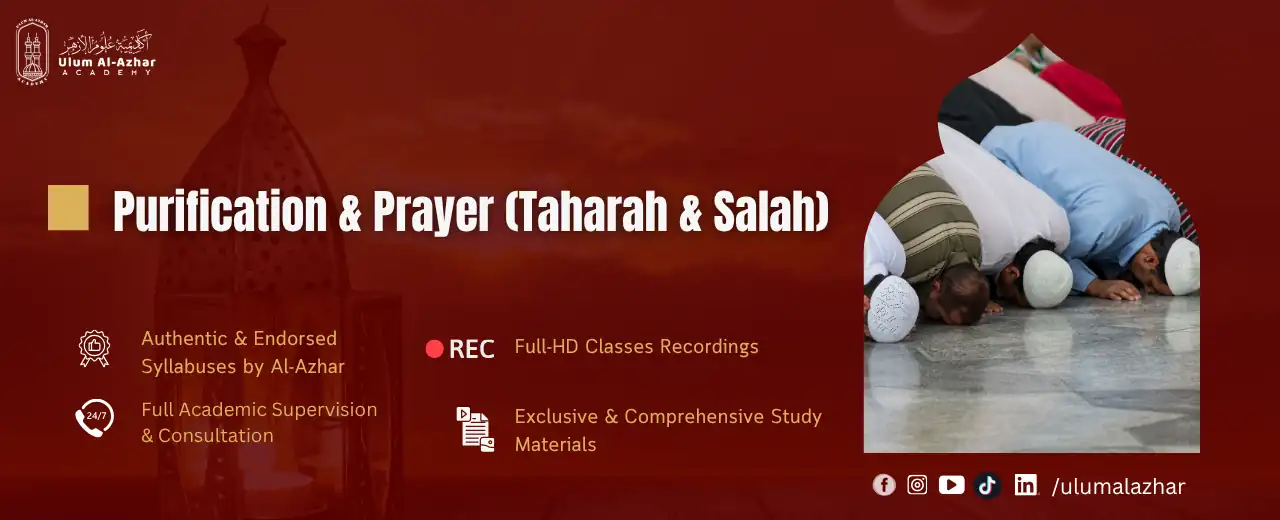
Ulum Al-Azhar Academy offers comprehensive guidance of step by step prayer in islam, through Purification & Prayer (Taharah & Salah).
The “Purification and Prayer” course provides a comprehensive guide to step by step prayer in islam: the essential practices of Taharah and Salah, including Wudu, Ghusl, and Tayammum. As well as the rules for leading prayers, special prayers, and funeral rites. This course combines theoretical knowledge with practical exercises, ensuring a complete understanding of these foundational Islamic practices.
Conclusion
Our prophet Muhammad, in the final days of his life, when the illness became severe, he would faint and then regain consciousness and ask, “Have the people prayed?” And the last advice he gave to the Muslims was regarding prayer, as he said: “Prayer, prayer, and those whom your right hands possess.”
Understanding the step by step prayer in islam helps Muslims appreciate the wisdom behind each movement and supplication. Prayer is a gift that nurtures humility, gratitude, and spiritual awareness throughout life.
Offering a free consultation with Al-Azhar-certified Sheikhs from Egypt to help you begin personalized Islamic learning.
FAQs
What is the first thing to learn in Salah?
The first thing beginners should learn is purification (wudu) and Surah Al-Fatihah, since both are essential for prayer.
How many times do Muslims pray daily?
Muslims pray five obligatory prayers each day: Fajr, Dhuhr, Asr, Maghrib, and Isha.
Can beginners read from a paper while praying?
No, the recitation should be from memory. If a person has not yet memorized what is recited in the prayer, they may remember Allah throughout the entire prayer by saying “Subhan Allah” and “Alhamdulillah” until they memorize Surah Al-Fatihah and the rest of the prayer recitations.
Can prayer be performed in English?
No, only recitations in Arabic are valid.
