
7 Steps of the Hajj Explained Clearly for First-Time Pilgrims
Table of Contents
Imagine a one-week journey from which you return with all your past sins forgiven. Yes, it is a demanding journey, but if you are sincere to Allah, you return from it with the reward of forgiveness and Paradise. For first-time pilgrims, understanding the 7 steps of the hajj can feel overwhelming because each ritual carries deep spiritual meaning, historical significance, and specific rulings.
In this guide, we will explain the 7 steps of the hajj in a simple and organized way so that first-time pilgrims can understand what happens during each stage, the meaning behind every ritual, common mistakes to avoid, and helpful tips for a smoother pilgrimage experience.
Unlock personalized Islamic learning by booking a free consultation with Al-Azhar-certified Sheikhs from Egypt.
The 7 Steps of the Hajj Explained Clearly
Understanding the 7 steps of the hajj begins with knowing the sequence of the rituals. While some details differ slightly depending on the type of Hajj being performed, the essential stages remain the same.
Hajj has essential pillars without which the pilgrimage is not valid. These are:
- entering into Ihram with the intention of Hajj,
- standing at Arafah,
- Tawaf al-ifadah,
- and Sa‘i between Safa and Marwah.
As for the obligatory acts of Hajj. If a Muslim deliberately leaves one of them, they must offer a sacrificial animal and distribute it to the poor of Mecca. These steps are:
- entering Ihram from the Miqat,
- staying at Arafah until sunset,
- spending the night in Muzdalifah on the night before Eid al-Adha,
- spending the nights of the Days of Tashreeq in Mina,
- stoning the Jamarat at Jamrat al-‘Aqabah on the day of Eid, and at the three Jamarat during the Days of Tashreeq,
- shaving or trimming the hair, and
- performing the Farewell Tawaf.
Anything beyond these previous pillars and obligatory acts of Hajj is considered Sunnah and recommended practices. For example: spending the night in Mina on the 8th day of Dhul Hijjah, performing Tawaf al-Qudum, and performing ghusl before entering Ihram, along with other recommended Sunnahs that are encouraged for the pilgrim to observe in following the example of the Prophet ﷺ. However, no penalty is required for leaving any of these recommended acts.
By combining the pillars, the obligatory acts and sunnah acts, the 7 steps of the hajj can be summarized in the following order, along with a brief explanation of each step:
What Happens in Each Step
The 7 steps of the hajj are not random movements or symbolic ceremonies without purpose. Each step includes acts of worship tied to remembrance, discipline, and submission to Allah.
(What is highlighted in red is a pillar (Rukn), while what is highlighted in orange is an obligatory act (Wajib)).
1- Ihram must be entered with the intention of Hajj from the Miqat. After entering Mecca, the pilgrim performs Tawaf al-Qudum (the Arrival Tawaf) which is sunnah.
2- Remaining at Arafat are boundaries on day 9th until sunset.
3- Spending the night in Muzdalifah on the night before Eid al-Adha.The Prophet ﷺ permitted the weak, women, and children to leave for Mina during the latter part of the night to avoid the crowd and to throw the pebbles before the arrival of the people.
4- Stoning the Jamarat al-‘Aqabah on the Day of Eid Al-Adha then Shaving the head or shortening the hair
5- On the same day of Eid Al-Adha go to Makkah to perform the pillar of Hajj Tawaf al-ifadah and sai’.
6- Spending the nights of the Days of Tashreeq in Mina and stoning the three Jamarat during these days.
7- Farewell Tawaf طواف الوداع , because the Prophet ﷺ commanded it when he said: “No one should leave until his last act is at the House.” Narrated by Muslim ibn al-Hajjaj.
Types of Tawaf in Hajj and the Ruling of Each Type
There are three types of Tawaf during Hajj, and each one has its rule:
1. Tawaf al-Qudum (Arrival Tawaf) طواف القدوم
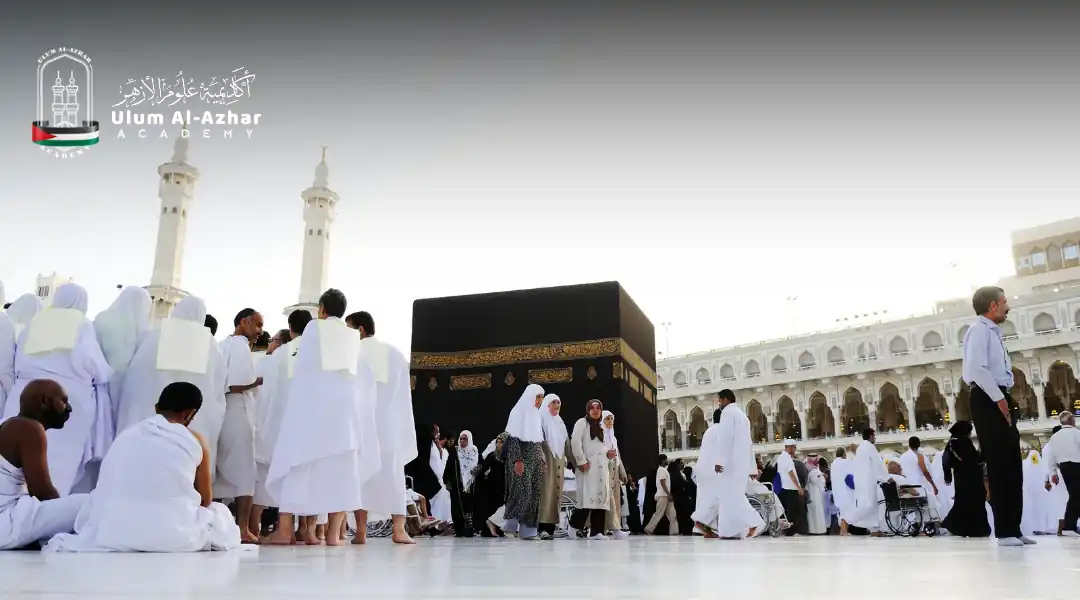
This is the Tawaf performed by pilgrims upon arriving in Mecca -after Ihram- before beginning the main rituals of Hajj.
- Ruling: Sunnah for those performing Ifrad or Qiran Hajj.
- It is not required for pilgrims performing Tamattu‘ if they already performed Tawaf for Umrah.
2. Tawaf al-ifadah طواف الإفاضة
It is a pillar (Rukn) of Hajj. It is also called Tawaf al-Ziyarah and sometimes Tawaf al-Hajj because Hajj is not valid without it, based on the saying of Allah.
3. Tawaf al-Wada‘ (Farewell Tawaf) طواف الوداع
It is an obligatory act of Hajj. Whoever leaves it must offer a sacrificial penalty. Whoever intends to leave Mecca at the end of Hajj should not depart until performing the Farewell Tawaf.
Menstruating women and women experiencing postnatal bleeding are exempt; they may leave Mecca without performing Tawaf al-Wada‘, and nothing is required from them.
Common Mistakes Pilgrims Make
First-time pilgrims sometimes make errors in 7 steps of the hajj due to lack of preparation or misunderstanding. Learning about these mistakes beforehand helps improve the Hajj experience.
- Passing the Miqat without entering Ihram, whether the Miqat is crossed by air, sea, or land. Whoever passes it without Ihram must offer a sacrifice.
- Performing the obligatory prayer while wearing the lower Ihram garment without the upper garment, as many people pray while their backs and shoulders remain uncovered.
- Excessive crowding and pushing at the Black Stone, causing harm to others. If kissing it is possible, then it may be kissed; otherwise, it is sufficient to touch it with the hand and kiss the hand. If that is difficult, one may simply point toward it.
- Wiping or rubbing against the corners of the Kaaba, its covering, its walls, the Maqam مقام إبراهيم عليه السلام , Hijr Isma‘il, or parts of the mosque, although none of this has any basis in the Sunnah.
- Believing that one must strictly follow the printed supplications assigned for each circuit of Tawaf and seeking someone to recite them aloud for guidance, even though general remembrance and personal supplication are sufficient.
- Being careless when shortening the hair after exiting Ihram by cutting only a small portion of the hair for men. This is incorrect; rather, all of the hair should either be shortened or completely shaved.
- Forcing oneself to climb Jabal al-Rahmah on the Day of Arafah, wiping against it, and believing that it has a special virtue requiring such actions.
- Occupying oneself in Muzdalifah with collecting pebbles before prayer, even though the pebbles may also be collected from Mina or elsewhere.
- Believing that the Jamarat are actual devils, then throwing shoes or large stones at them while cursing and insulting them, even though the stoning is an act of worship and a reminder of the enmity of Satan.
- Believing that Hajj is incomplete without visiting Medina and placing unnecessary hardship upon oneself to do so.
Tips for First-Time Pilgrims
Learn the Rituals Before Traveling: Study the pillars and the 7 steps of the hajj carefully before departure. Understanding the sequence reduces confusion and anxiety during the pilgrimage.
Stay Patient: Crowds, heat, and long walking distances are normal during Hajj. Patience is among the greatest acts of worship during the pilgrimage.
Travel Light: Avoid carrying unnecessary items. Comfortable footwear, water, and essential documents are usually sufficient.
Keep Making Du‘a: Hajj is filled with moments when supplications are accepted. Prepare a list of personal du‘a before traveling.
Stay With Your Group: Large crowds can make it easy to become separated. Pilgrims should maintain communication with their group leaders and companions.
Protect Your Health: Rest when needed, drink sufficient water, and avoid exhausting yourself unnecessarily. Islam encourages balance and avoiding harm.
Sacred Months in Islam & Blessed Times course emphasizes the importance of seizing sacred months, the holy month of islam, and blessed times. You will get to know holy months in islam, blessed times and seasons, how to get the maximum benefit in these times, and how to get baraka in islam. “and remind them of the days of Allah”.
Conclusion
To make the 7 steps of the hajj easier to understand, the rituals of Hajj can be divided into three categories. The first category is the pillars (Arkan), without which Hajj is not valid, and they are four pillars: entering Ihram with the intention, standing at Arafat, Tawaf al-Ifadah, and Sa‘i between Safa and Marwah.
The second category is the obligatory acts (Wajibat) , where Hajj remains valid if they are omitted, but the pilgrim must offer a sacrifice as compensation. Anything beyond the pillars and obligatory acts belongs to the third category, which is the recommended Sunnah practices.
For first-time pilgrims, understanding these rituals beforehand can remove confusion and allow greater focus on spirituality. Hajj is not merely a physical trip to Mecca; it is a journey toward Allah through worship, repentance, and devotion.
A free consultation with Al-Azhar-certified Sheikhs from Egypt is your gateway to personalized Islamic learning.
FAQs
Why is Arafah important in Hajj?
The Day of Arafah is the greatest pillar of Hajj. Pilgrims spend the day inside Arafat are boundaries in worship, repentance, and supplication.
Can women perform all the rituals of Hajj?
Yes, women perform the same rituals as men, though some rulings differ slightly regarding clothing and the women who are menstruating or experiencing postnatal bleeding.
What is the Greatest Day of Hajj?
It is the Day of Sacrifice (Yawm al-Nahr), which is the day of Eid al-Adha on the 10th of Dhul Hijjah.
How long does Hajj usually take?
Hajj rituals are mainly performed over 5-6 days during Dhul Hijjah, though many pilgrims stay longer before or after completing the rituals.
What should first-time pilgrims focus on most?
Sincerity, patience, learning the rituals properly, and maintaining remembrance of Allah throughout the journey.
Is Hajj physically difficult?
Hajj can be physically demanding because of crowds, walking, and weather conditions. Proper preparation and patience help pilgrims complete the journey more comfortably.
