
Fitr Zakat Calculator: Amount, Rules, and Food vs Money Explained
Table of Contents
Zakat al-Fitr was prescribed in the second year after the Hijrah, which is the same year in which Allah made the fasting of Ramadan obligatory. The evidence for its legitimacy is established in the Sunnah through several hadiths, including the narration of Ibn Abbas رضي الله عنه, who said: “The Messenger of Allah ﷺ made Zakat al-Fitr obligatory.”
Zakat al-Fitr was legislated for several wise purposes. Among them is to compensate for any shortcomings that may occur during fasting. It is also intended to relieve the poor from having to ask for help, and providing for the poor is one of the objectives emphasized by Islamic law and its higher purposes. In addition, this charity strengthens social solidarity within the community, promotes compassion among its members, and encourages people to care for one another.
In modern times, many Muslims as New Muslims in Canada ask about the fitr zakat calculator to determine the correct amount they should give. Fitr zakat calculator, which helps individuals and families calculate their obligation accurately according to the number of people in their household.
We will explore how a fitr zakat calculator works, how Zakat Eid Ul Fitr is calculated per person, whether it should be given as food or money, the proper time to pay it, and who is eligible to receive it according to Islamic teachings.
Claim your free consultation now and start your path to knowledge!
What Is a Fitr Zakat Calculator and Why Muslims Use It
The Islamic law stipulates Zakat al-Fitr :
– Must be given on behalf of every Muslim who possesses more food than what is needed for the night of Eid, whether male or female, young or old.
– Each person gives it for themselves, and a man is responsible for paying it on behalf of those he is obligated to support financially, such as his children and his wife, if she does not have her own wealth.
– The obligation of Zakat al-Fitr becomes due at sunset on the last day of Ramadan.
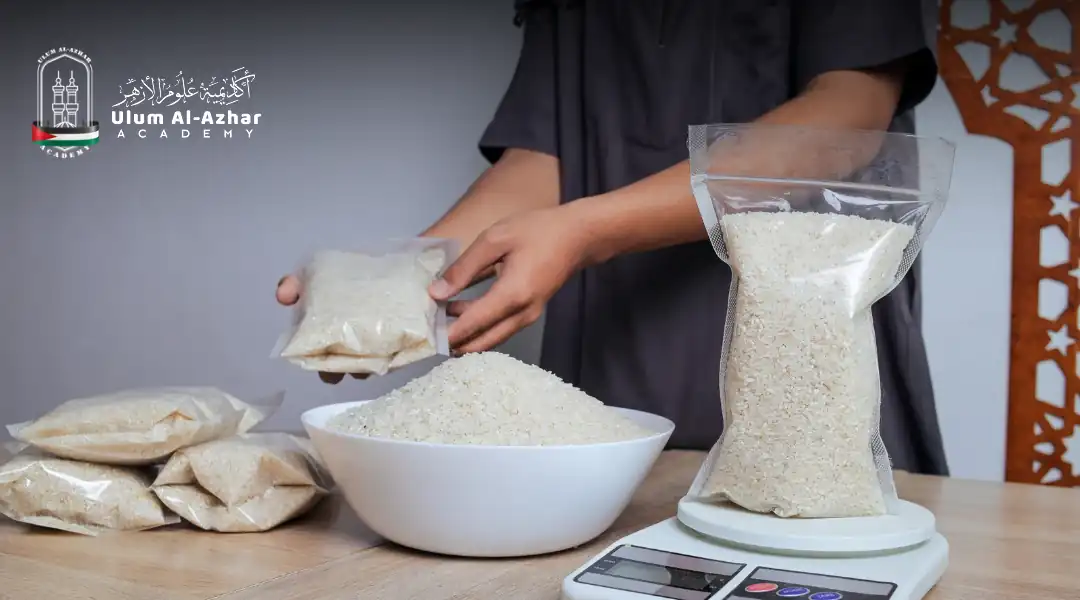
– A fitr zakat calculator determine that Zakat al-Fitr is one ṣāʿ (صاع) of staple food such as wheat, barley, rice, or dates. In modern measurements, this quantity is generally estimated to be approximately 2.5–3 kilograms of food per person.
How to Calculate Zakat Eid Ul Fitr Per Person Using a Fitr Zakat Calculator
The obligation of Zakat al-Fitr applies to every Muslim who has enough food for themselves and their dependents on the day and night of Eid. The head of the household is responsible for paying it on behalf of those under their care, including children.
A fitr zakat calculator simplifies the calculation process by following a few straightforward steps:
Step 1: One Ṣāʿ of Food = 2.5–3 kilograms of staple food
Step 2: Count the Number of People in the Household
The person responsible for paying Zakat al-Fitr must include:
- Himself or herself
- Spouse
- Children
- Everyone he financially supports as elderly parents
For example, if a household includes two parents and three children, the total number of individuals would be five.
Step 3: Multiply the Amount Per Person
Amount of food:
if a person intends to give 3 kilograms of rice,
Therefore, the previous family must give 3 × 5 = 15 kilograms of rice as Zakat al-Fitr.
Amount of money:
To determine the monetary value of Zakat al-Fitr, the price of 3 kilograms of the grain that will be given should be calculated based on the price per kilogram.
For example, if a person intends to give 3 kilograms of rice, and the price of one kilogram is $2, then the total value for one person would be:
3 × 2 = $6 per person
If a family consists of five people, then the Zakat due for the entire family would be:
5 × 6 = $30 for the family
Step 4: Pay the Charity Before Eid Prayer
After calculating the total, the amount should be distributed to eligible recipients before the Eid prayer. Using a fitr zakat calculator ensures that the obligation is fulfilled correctly and on time.

Giving Zakat Eid Ul Fitr as Food vs Money in Islamic Law
One of the most discussed questions about Zakat al-Fitr is whether it must be given as food or whether giving money is also acceptable.
Giving Food
The original practice during the time of the Prophet ﷺ was to give Zakat al-Fitr as staple food. Companions used to distribute dates, barley, wheat, or raisins to the poor so they would have enough provisions on the day of Eid.
The purpose behind this practice was to ensure that the needy had food for themselves and their families, allowing them to celebrate Eid with dignity.
Giving Money
Scholars have permitted giving Zakat al-Fitr in monetary value, meaning it may be given to eligible families as money instead of grains. Evidence for this includes the practice of several prominent companions such as the Commander of the Faithful Umar ibn al-Khattab, his son Abdullah ibn Umar, Abdullah ibn Mas‘ud, Abdullah ibn Abbas, Mu‘adh ibn Jabal, and Al-Hasan ibn Ali رضي لله عنهم جميعا.
Al-Bukhari narrated in his Sahih that Mu‘adh رضي الله عنه said to the people of Yemen:
“Bring me goods, such as garments or clothing, instead of barley and corn as charity; it is easier for you and better for the companions of the Prophet ﷺ in Madinah.”
This indicates that he accepted from those paying zakat what matched the needs of the poor and needy, instead of restricting it to the specific type of goods in which the zakat was originally due.
As for the Successors (Tabi‘un), the permissibility of giving Zakat al-Fitr in monetary value was also supported by the rightly guided caliph Umar ibn Abd al-Aziz and Imam Tawus. They were later supported by scholars such as Imam al-Thawri and Imam al-Bukhari, among others.
A fitr zakat calculator simply translates the required quantity of food into a clear monetary amount that donors can easily provide.
Take a closer look at the Difference Between Zakat and Sadaqah

When Should Zakat Eid Ul Fitr Be Paid Before Eid Prayer
The timing of Zakat Eid al-Fitr is an important part of fulfilling this obligation properly. Islamic teachings emphasize that it should be paid before the Eid prayer, so that the poor can benefit from it on the day of Eid itself.
It is reported from Ibn Umar رضي الله عنه that the Prophet ﷺ commanded that Zakat al-Fitr be given before people go out for the Eid prayer. Allah the Almighty also says:
“He has certainly succeeded who purifies himself, and mentions the name of his Lord and prays.” ( Al-A’la 14)
Zakat al-Fitr has two specific times: a time when it becomes obligatory and a time when it may be paid.
Time When It Becomes Obligatory
The preferred scholarly opinion is that Zakat al-Fitr becomes obligatory at sunset on the last day of Ramadan. This is the view held by the Maliki, Shafi‘i, and Hanbali schools of jurisprudence.
Time When It May Be Paid
As for the time of payment, it is permissible to give Zakat al-Fitr before the night of Eid. Imam Malik and Imam Ahmad held that it may be given one or two days before Eid, while Imam Al-Shafi‘i held that it is permissible to give it from the beginning of Ramadan.
Ibn Umar (may Allah be pleased with them both) also said: “They used to give it one or two days before Eid al-Fitr.”
The phrase “they used to give” refers to the companions of the Messenger of Allah ﷺ, and following their practice is the most appropriate course.
If It Is Delayed
– If someone delays paying Zakat al-Fitr until after the Eid prayer without a valid reason, it is no longer considered Zakat al-Fitr in its proper time but rather a regular charity. Nevertheless, the obligation of giving it remains and It must be paid immediately once it is remembered.
– However, if it is delayed due to an excuse such as forgetfulness, then there is no sin upon him, based on the saying of the Messenger of Allah ﷺ:
“My nation has been pardoned for mistakes, forgetfulness, and what they are compelled to do.”
But also the obligation of giving it remains and It must be paid immediately once it is remembered.
Because of this time sensitivity, many charitable platforms encourage donors to use a fitr zakat calculator early in the last days of Ramadan so the payment can reach beneficiaries on time.
Who Should Receive Zakat Eid Ul Fitr According to Islamic Rules
Zakat al-Fitr should be given to the poor and the needy, rather than to the other eight categories of Zakat recipients. It is not permissible to give it to those whose financial support is already obligatory upon a person, nor is it permissible to give it to non-Muslim protected citizens (Ahl al-Dhimmah).
It is permissible to give Zakat al-Fitr to one poor person or to several poor people. However, it is preferable to give it to poor relatives, provided that their financial support is not already the responsibility of the one giving the zakat.
Scholars have also stated that giving Zakat al-Fitr in monetary form in our time may be preferable, because the main objective of zakat is to provide sufficiency for the poor. This goal can be achieved through food, but it can also be achieved through money. In fact, in our time money may be more beneficial and easier.
This is because if everyone were to give the poor only food, many needy people would still have to sell that food in order to pay their essential expenses, such as electricity bills, water bills, and other necessary costs. This is one of the main reasons why giving its value in money can be more practical today.
When using a fitr zakat calculator, donors typically determine the total amount they owe and then distribute it to these eligible people.
The purpose of this charity is not merely financial support but also social compassion, strengthening the bonds of the Muslim community.
Learn Shariah through the method of Talaqqi Kitab Turath (Traditional Study) and get certificates endorsed by scholars from AL Azhar (Ijazah Sanad).

Conclusion
As the blessed month of Ramadan comes to an end, Muslims around the world prepare to celebrate Eid al-Fitr. Before attending the Eid prayer, however, there is an important act of worship that every eligible Muslim must fulfill: Zakat al-Fitr, also known as Fitr Zakat. This charitable obligation purifies the fasting person and ensures that the poor can share in the joy of Eid.
Zakat al-Fitr is the charity that a Muslim must give before the Eid al-Fitr prayer in a specified amount—one ṣāʿ of the staple food of the country—on behalf of every Muslim. The head of the household gives it on behalf of those whose financial support is his responsibility.
Grab your free consultation session and take the first step toward learning!
FAQs
What is the amount of Zakat al-Fitr per person?
The amount is traditionally one ṣāʿ of staple food, which is roughly 2.5–3 kilograms.
Who must pay Zakat al-Fitr?
Every Muslim who has sufficient food for themselves and their dependents on the day and night of Eid must pay it. The head of the household typically pays on behalf of family members.
Can Zakat al-Fitr be given in money?
Yes, many scholars allow giving the monetary equivalent of the food when it is more beneficial for the poor. A fitr zakat calculator helps determine the correct value.
When should Zakat al-Fitr be paid?
It should ideally be given before the Eid prayer, preferably during the last days of Ramadan.
