
Transliteration of Surah An Nas With Meaning
Table of Contents
The transliteration of Surah An Nas is one of the most accessible ways for Muslims—especially non-Arabic speakers as in Canada and many other countries—to connect with the final chapter of the Qur’an.
Surah An-Nas is a Meccan surah, and its main theme is seeking refuge and protection in Allah from the evil of Satan, the whisperer who withdraws. By learning the transliteration of Surah An Nas, readers can recite it correctly while gradually understanding its deeper meanings.
These lines explore the transliteration of Surah An Nas, its pronunciation, meaning, benefits, and practical application in daily life.
Complete Transliteration of Surah An Nas
Surah An Nas is the 114th and last chapter (Surah) of the Qur’an. Surah Al-Falaq protects the Muslim from external evils, such as the evils of the night and what it contains, the evils of envy, and the evils of sorcerers. Then comes Surah An-Nas to seek refuge for you from internal evils—“from the evil of the whisperer who withdraws.”
Below is the full transliteration of Surah An Nas presented clearly for easy reading and memorization:
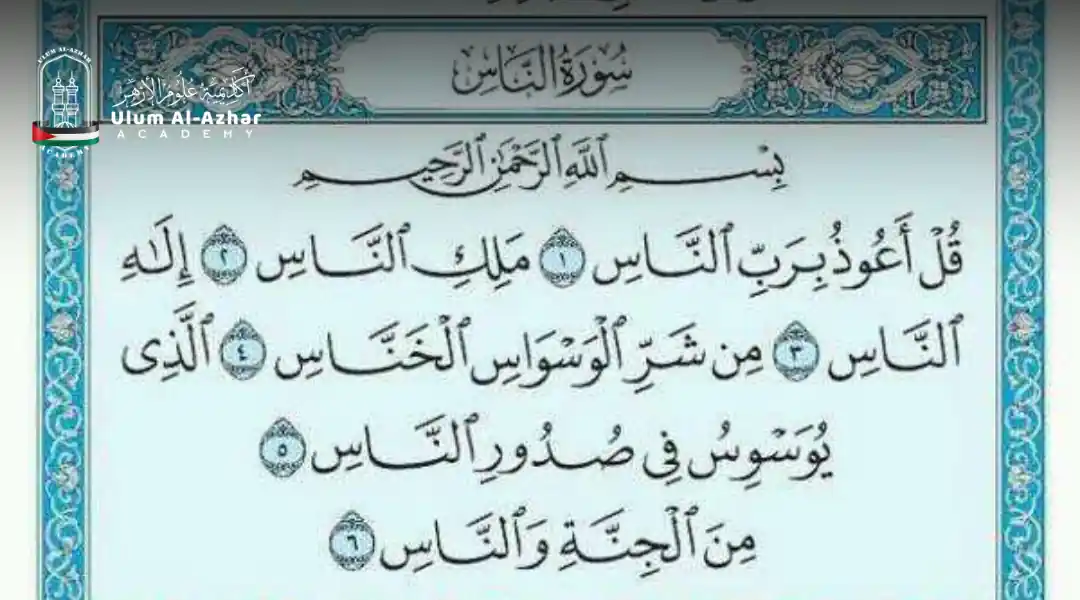
قُلْ أَعُوذُ بِرَبِّ ٱلنَّاسِ ١ مَلِكِ ٱلنَّاسِ ٢ إِلَـٰهِ ٱلنَّاسِ ٣ مِن شَرِّ ٱلْوَسْوَاسِ ٱلْخَنَّاسِ ٤ ٱلَّذِى يُوَسْوِسُ فِى صُدُورِ ٱلنَّاسِ ٥ مِنَ ٱلْجِنَّةِ وَٱلنَّاسِ ٦
Bismillāh ir-Raḥmān ir-Raḥīm
Qul a‘ūdhu birabbi-n-nās
Maliki-n-nās
Ilāhi-n-nās
Min sharri-l-waswāsi-l-khannās
Alladhī yuwaswisu fī ṣudūri-n-nās
Mina-l-jinnati wa-n-nās
Begin your comprehensive Islamic learning journey; it all starts with free consultation and Al-Azhar-certified Sheikhs in Egypt.
Correct Pronunciation Guide for Beginners
When learning the transliteration of Surah An Nas, proper pronunciation (tajweed) should not be overlooked. Even though transliteration helps bridge the gap, attention to sounds is essential for correct recitation.
Here are some key tips:
- Qul (قُل): The “Q” sound comes from the back of the throat. It is heavier than a regular “k.”
- A‘ūdhu (أعوذ): The letter ‘ayn (ع) is a deep throat sound. All the letters are pronounced lightly (with tarqīq), and the wāw is a natural elongation (madd ṭabī‘ī), extended for two counts when continuing (in connected recitation).
- Rabbi-n-nās (رَبِّ النَّاس): In the word “Rabbi”, the rā’ is pronounced with heaviness (tafkhīm), while the bā’ is light (tarqīq). The kasrah (the “i” sound) on the bā’ must be pronounced clearly and precisely.
In the word “An-Nās” the nūn when it is doubled (mushaddadah), it should be pronounced with a ghunnah (nasal sound) for a duration of two counts.
- In the phrase “min sharri”, word min all the letters are pronounced lightly (tarqīq).
The nūn sākinah in “min” is followed by the letter shīn, which is one of the letters of ikhfā’ ḥaqīqī (true concealment) in the rules of nūn sākinah. Therefore, the ruling here is ikhfā’ with ghunnah, meaning the nūn sound is partially hidden and pronounced with a soft nasalization. This ghunnah should be light (muraqqaqah) and held for two counts (ḥarakatayn).
- Al Khannās (الخَنَّاس): the lām in “al-” is lām qamariyyah, so it is pronounced clearly (iẓhār).
The letter khā’ (خ) is pronounced with heaviness (tafkhīm), while the nūn is light (tarqīq) and doubled (mushaddadah), so it must be pronounced with a complete ghunnah (nasal sound) for two counts (ḥarakatayn).
These are just some notes to help improve your recitation. As for mastering recitation and learning how to pronounce the remaining words correctly, you can join a Tajweed course, where you will gain a deeper understanding with practical applications of all Tajweed rules, explained in a simple way by teachers who are graduates of Al-Azhar Al-Sharif.
Practicing the transliteration of Surah An Nas alongside listening to skilled reciters can significantly improve pronunciation.
Meaning and Protection Benefits of the Surah
Understanding the meaning behind the transliteration of Surah An Nas transforms recitation into a deeply spiritual experience. The surah is a direct appeal to Allah for protection from unseen harm.
Meaning (simple explanation):
- “Say: I seek refuge in the Lord of mankind” —“The King of mankind” — “The God of mankind” — These are among the attributes of the Lord, the Most Glorious and Exalted: Lordship, Sovereignty, and Divinity. He is the Lord of everything, its King, and its God. All things are created by Him, owned by Him, and are His servants.
- “From the evil of the whisperer who withdraws” — “Who whispers into the hearts of mankind” — : Al-waswasah refers to what Satan casts into the heart—thoughts, illusions, and baseless imaginations that have no reality. Al-khannās is the one who withdraws, retreats, and is driven back when Allah is remembered—this refers to Satan.
- “From among jinn and mankind” — Whispering (waswasah) can come from both jinn and humans.
The transliteration of Surah An Nas is often used in daily recitation for protection. It is commonly paired with Surah Al-Falaq and Surah Al-Ikhlas as part of spiritual safeguarding practices. Benefits include:
- Protection from negative thoughts and whispers
- Strengthening reliance upon Allah
- Spiritual comfort during anxiety or fear
- Reinforcing awareness of unseen influences

When Muslims Recite Surah An Nas
The transliteration of Surah An Nas is widely used in several daily and special situations:
1. Morning and Evening Adhkar
The Prophet ﷺ said to ʿAbdullāh ibn Khubayb: “Say: ‘Qul Huwa Allahu Ahad’ and the two Muʿawwidhatayn (Surah Al-Falaq and Surah An-Nas) three times in the evening and in the morning; they will suffice you against everything.”
- After every prayer:
It is reported from ʿUqbah ibn ʿĀmir رضي الله عنه that he said: “The Messenger of Allah ﷺ instructed me to recite the two Muʿawwidhatayn (Surah Al-Falaq and Surah An-Nas) after every prayer.”
3. Before Sleeping
It is reported from ʿĀ’ishah رضي الله عنها that the Prophet ﷺ, when he went to his bed every night, would bring his hands together, then lightly blow into them, and recite into them: “Qul Huwa Allahu Ahad,” “Qul A‘ūdhu bi Rabbil-Falaq,” and “Qul A‘ūdhu bi Rabbin-Nās.” Then he would wipe with them whatever he could of his body, starting with his head, his face, and the front of his body. He would do that three times.
4. During Times of Fear or Anxiety
It is reported from ʿUqbah ibn ʿĀmir that he said: “While I was traveling with the Messenger of Allah ﷺ between Al-Juhfah and Al-Abwā’, we were overtaken by a strong wind and intense darkness. So the Messenger of Allah ﷺ began seeking refuge by reciting: ‘Aʿūdhu bi Rabbil-Falaq’ and ‘Aʿūdhu bi Rabbin-Nās.’”
- During illness:
It is reported from ʿĀ’ishah رضي الله عنها that the Messenger of Allah ﷺ, when he became ill, would recite the Muʿawwidhāt (the protective surahs) over himself and lightly blow. When his illness became severe, I would recite over him and wipe him with his own hand, seeking its blessing.
6. In Ruqyah (Spiritual Healing) For Children and adults.
It is reported from Abu Saʿīd al-Khudrī رضي الله عنه that the Messenger of Allah ﷺ used to seek refuge from the evil eye of the jinn and the evil eye of humans. When the two Muʿawwidhatayn (Surah Al-Falaq and Surah An-Nas) were revealed, he held fast to them and left aside other supplications.
Learning Short Surahs with Ulum Alazhar Academy
Save time & effort by Ulum Al-Azhar Classes | Tajweed & Talaqqi Mastery Track with Ijazah Sanad where you study Tajweed and Quran, which are aligned with each other by qualified lecturers from Al-Azhar Al-Sharif.
The transliteration of Surah An Nas often serves as a starting point for beginners. With proper guidance, learners can move beyond transliteration toward fluent and confident recitation.
Conclusion
The transliteration of Surah An Nas is more than just a learning tool—it is a gateway to understanding and internalizing one of the most powerful chapters of the Qur’an.
The Muʿawwidhāt are the three surahs with which Allah, the Exalted, concluded His Book. They are among the greatest three surahs revealed in the Torah, the Gospel, the Psalms, and the great Qur’an.
Several prophetic hadiths mention their virtue, including It is reported from ʿUqbah ibn ʿĀmir that the Messenger of Allah ﷺ said:
“Have you not seen verses revealed tonight, the like of which has never been seen before: ‘Qul Aʿūdhu bi Rabbil-Falaq’ and ‘Qul Aʿūdhu bi Rabbin-Nās.’”
The first step in your Islamic learning journey is free consultation, featuring Al-Azhar-certified Sheikhs in Egypt.
FAQs
1. Why is the transliteration of Surah An Nas important?
It helps non-Arabic speakers recite the surah correctly while they learn Arabic gradually.
2. Can I rely only on transliteration?
Transliteration is a helpful starting point, but learning Arabic reading is encouraged for accurate recitation.
3. How often should I recite Surah An Nas?
It is recommended to recite it daily, especially in the morning, evening, and before sleep.
