
How to Prayer Tahajjud Step by Step for Beginners
Table of Contents
Prayer is one of the greatest physical acts of worship in Islam and among the best voluntary deeds a Muslim offers to Allah Almighty. It is the connection between the servant and his Lord, and the closest a servant comes to his Lord is while in prostration. Then how much greater is it when it is performed at the best of times — the last third of the night — when the Lord, Glorious and Exalted, descends, forgives those who seek forgiveness, answers those who call upon Him, and grants those who ask.
The prayer at that time is called Tahajjud prayer. It is a voluntary night prayer that brings the believer closer to Allah. For beginners, learning how to pray tahajjud may seem challenging at first, but with proper understanding, sincere intention, and consistent practice, it becomes a source of peace, comfort, and purifies the soul from worries and sorrows.
This guide will help Muslims in Canada and many other countries as it will explain how to prayer tahajjud step by step in a simple and practical way, making it easy for beginners to understand and implement. You will learn the correct timing, the number of rak‘ahs, intentions, recommended supplications, and the spiritual philosophy behind this blessed act of worship.
How to Prayer Tahajjud Step by Step for Beginners
Understanding how to prayer tahajjud begins with understanding the difference between Qiyām al-Layl and Tahajjud: both terms refer to voluntary worship performed at night after the ‘Isha prayer.
Qiyām al-Layl refers to spending the night, or part of it — even if only an hour — in prayer, recitation of the Qur’an, remembrance of Allah, and other acts of worship.
Tarāwīḥ, it is the term used by scholars to refer to the night prayer in Ramadan that is performed at the beginning of the night.
As for Tahajjud, it refers specifically to the night prayer, and some scholars have restricted it to the prayer performed after sleeping.
Thus, it becomes clear that Qiyām al-Layl is broader and more comprehensive than Tahajjud, because it includes prayer and other forms of worship, and it includes prayer both before sleeping and after sleeping.
Tahajjud, however, is specific to prayer only, and there are two scholarly views regarding it:
The first view: It refers to the night prayer in general, and this is the opinion of the majority of scholars.
The second view: It refers specifically to prayer after a period of sleep, even if it is a short sleep during the night.
Initiate your Islamic learning journey by enrolling in free consultation with Al-Azhar-certified Sheikhs from Egypt.
Now, these are the steps of how to prayer tahajjud:
1.Make Wudu (Ablution): Cleanliness is part of worship and prepares the heart for prayer.
2. Choose a Quiet Place: Stand in a calm, clean, and quiet space. Tahajjud is a private conversation between you and Allah.
3. Make the Intention (Niyyah): The intention is made in the heart, not spoken aloud. Simply intend to perform Tahajjud prayer for the sake of Allah.
4. Pray Two Rak‘ahs at a Time: Pray in sets of two rak‘ahs. In each rak‘ah, Surah al-Fātiḥah is recited along with some verses from the Qur’an, whether a few verses or more. You may recite from the Mushaf (the Qur’an) or from memory, from what you have memorized.
The first rak‘ah is performed without the tashahhud, as in any regular prayer, and in the second rak‘ah, the full tashahhud is recited after the prostration (Sujud), then the two rak‘ahs are finished with the salām.
how to prayer tahajjud including that you may pray any number of rak‘ahs you wish, divided into sets of two as previously explained, and then conclude the prayer with the Witr prayer, which may be three rak‘ahs or a single rak‘ah.
This simple structure explains how to prayer tahajjud in a way that is accessible and practical. You may supplicate with whatever you wish during the prostration of any rak‘ah, or after rising from the bowing (rukū‘) of the final rak‘ah in the Witr prayer.
Number of Rak‘ahs in Tahajjud
For deeper understanding about how to prayer tahajjud: Tahajjud is prayed in sets of two rak‘ahs, and it is recommended to conclude it with a single rak‘ah as Witr. In the two authentic collections (al-Bukhārī and Muslim), the Messenger of Allah ﷺ said:
“The night prayer is performed in pairs of two. If one of you fears the coming of dawn, let him pray one rak‘ah, which will make what he has prayed odd (Witr).”
So minimum number: 2 rak‘ahs, common practice: 4, 6, or 8 rak‘ahs, and there is no harm in limiting it to 11 rak‘ahs or 13 rak‘ahs (including witr) , as it has been authentically reported that the Messenger of Allah ﷺ did not exceed that number in Ramadan or outside of Ramadan.
Get to know our role model: Prophet Muhammad by studying his life, character, attributes, and teaching style.
Best Time to Wake Up for Tahajjud Prayer
We now know how to prayer tahajjud, as for the best time for Tahajjud, is the latter half of the night, meaning after midnight.
Ibn Qudāmah said: “The best time for Tahajjud is the deepest part of the latter part of the night.” This is based on the narration of ‘Amr ibn ‘Abasah, who said: I asked: ‘O Messenger of Allah, which part of the night is most responsive (to dua)?’ He replied: ‘The deepest part of the latter night, so pray as you wish.’ (Narrated by Abū Dāwūd).
The Prophet ﷺ also said: “The best prayer is the prayer of Dāwūd (David). He used to sleep for half of the night, pray for one-third of it, and sleep for one-sixth of it.”
And in the hadith of Ibn ‘Abbās describing the Tahajjud of the Messenger of Allah ﷺ: He slept until the middle of the night, or slightly before it, or slightly after it, then he woke up and prayed. He described his night prayer in detail, then said: ‘Then he performed Witr, then he lay down until the caller to prayer came.’
How to Calculate the Last Third of the Night:
- Calculate the time between Maghrib and Fajr.
- Divide it into three equal parts.
- The final third is the most virtuous time for Tahajjud.
Because the time of the last third of the night is, in general, the time of the Divine Descent, it is especially appropriate for supplication and seeking forgiveness. This is based on the saying of the Prophet ﷺ:
“Our Lord, Blessed and Exalted, descends every night to the lowest heaven when the last third of the night remains and says: ‘Who is calling upon Me so that I may answer him? Who is asking Me so that I may give him? Who is seeking My forgiveness so that I may forgive him?’” (Agreed upon; this is the wording of al-Bukhārī.)
Ibn Kathīr رحمه الله said:
“‘Abdullāh ibn ‘Umar used to pray at night, then he would say: ‘O Nāfi‘, has the time of saḥar (the pre-dawn time) come?’ — When Nāfi‘ said ‘Yes,’ he would devote himself to supplication and seeking forgiveness until morning.”
The scholars have established that the best time for night prayer is the last third of the night. However, they recommended that the time of saḥar be devoted specifically to seeking forgiveness. Saḥar corresponds to the final sixth of the night. Thus, the time before this sixth is devoted to Tahajjud, worship, and Qur’anic recitation, following the example of the Prophet ﷺ, and then one dedicates oneself to seeking forgiveness, in accordance with the saying of Allah:
“And in the hours before dawn, they seek forgiveness.” [Surah adh-Dhāriyāt 18]
Intentions You Can Make When Performing Tahajjud
Night prayer (Qiyām al-Layl) is a divine legislation, a prophetic Sunnah, a private communion with the Lord of all creation, and a source of spiritual happiness that causes the soul to become attached to the highest levels of Paradise.
If you ask yourself, “Why should I stand in prayer at night?” then here are several intentions you can adopt:
- blessings and following the example of the Messenger ﷺ
- being among the truthful (ṣiddīqīn) and the martyrs (shuhadā’)
A man from Qudā‘ah came to the Messenger of Allah ﷺ and said:
“I bear witness that there is no god but Allah and that you are the Messenger of Allah. I pray the five daily prayers, I fast Ramadan and observe its night prayers, and I give zakah.”
The Messenger of Allah ﷺ said:
“Whoever dies upon this will be among the truthful and the martyrs.”
- I may be among the people of true faith: Allah تعالى says:
“Only those believe in Our verses who, when they are reminded of them, fall down in prostration and glorify the praise of their Lord, and they are not arrogant. Their sides forsake their beds, calling upon their Lord in fear and hope, and from what We have provided them they spend. And no soul knows what has been hidden for them of comfort for the eyes as a reward for what they used to do.” (Surah as-Sajdah 32:15–17)
- I learn how to prayer tahajjud so that I may be written among those who remember Allah abundantly
reported from Abū Hurayrah and Abū Sa‘īd (رضي الله عنهما) that the Messenger of Allah ﷺ said: “Whoever wakes up at night and wakes his family, and they pray two rak‘ahs together, they will be recorded among the men and women who remember Allah abundantly.
- I may be written among the devout, sincere worshippers, and not among the heedless
reported from Abū Hurayrah (رضي الله عنه) that the Prophet ﷺ said:
“Whoever prays one hundred verses in a night will not be written among the heedless, and whoever prays two hundred verses in a night will be written among the devout, sincere worshippers.”
- another niyyah about how to prayer tahajjud: it is the best prayer after the obligatory prayers
reported from Abū Hurayrah (رضي الله عنه) that the Messenger of Allah ﷺ said: “The best prayer after the prescribed prayer is prayer in the depths of the night.”
- I stand in prayer at night so that my Lord may grant me what I ask
Jābir (رضي الله عنه) said: I heard the Messenger of Allah ﷺ say: “Indeed, in the night there is an hour during which no Muslim servant asks Allah for any good of this world or the Hereafter except that He grants it to him — and that is every night.”
Duas Recommended After Tahajjud Prayer
What makes many people ask how to prayer Tahajjud is the virtue of supplication at this time.
‘Uqbah ibn ‘Āmir (رضي الله عنه) said: I heard the Messenger of Allah ﷺ say:
“Two men from my Ummah: one of them rises during the night and struggles against his own self to purify himself. He has knots upon him, and when he performs wudu’, one knot is untied when he washes his hands, another knot is untied when he washes his face, another knot is untied when he wipes his head, and another knot is untied when he washes his feet. Then the Lord, Mighty and Exalted, says to those behind the veil: ‘Look at this servant of Mine — he is striving against his own soul. Whatever My servant asks of Me, it is granted to him.’”
One of the most well-known supplications in Tahajjud prayer narrated by al-Bukhārī is the hadith of Ibn ‘Abbās (رضي الله عنهما), who said:
When the Prophet ﷺ would stand at night for Tahajjud, he would say:
“O Allah, to You belongs all praise. You are the Sustainer of the heavens and the earth and all that is within them. To You belongs all praise. To You belongs the dominion of the heavens and the earth and all that is within them. To You belongs all praise. You are the Light of the heavens and the earth and all that is within them. To You belongs all praise. You are the Sovereign of the heavens and the earth and all that is within them.
To You belongs all praise. You are the Truth, Your promise is true, Your meeting is true, Your word is true, Paradise is true, Hell is true. To You I have submitted, in You I have believed, upon You I rely, to You I turn in repentance, with Your help I contend, and to You I seek judgment. So forgive me for what I have sent ahead and what I have delayed, what I have concealed and what I have made public.
You are the One who brings forward and the One who delays. There is no god but You — or there is no god besides You. And there is no power nor strength except with Allah.”
The Messenger of Allah ﷺ also advised using comprehensive and complete supplications in general. He said to ‘Ā’ishah (رضي الله عنها):
“O ‘Ā’ishah, adhere to the comprehensive and perfect supplications. Say:
O Allah, I ask You for all good — its immediate and its delayed, what I know of it and what I do not know. And I seek refuge in You from all evil — its immediate and its delayed, what I know of it and what I do not know.O Allah, I ask You for Paradise and for whatever brings one closer to it of speech or action, and I seek refuge in You from the Fire and from whatever brings one closer to it of speech or action.
O Allah, I ask You for what Muhammad ﷺ asked You for, and I seek refuge in You from what Muhammad ﷺ sought refuge in You from. O Allah, whatever You decree for me, make its outcome for me righteousness and guidance.”
How Ulum Al-Azhar Academy Teaches Tahajjud for Spiritual Growth
During the Prophet’s ﷺ migration to Madinah, night prayer (Qiyām al-Layl) was among the very first acts of worship that he encouraged, called people to, and urged them to practice. Abdullāh ibn Salām (رضي الله عنه) said:
“When the Messenger of Allah ﷺ arrived in Madinah, the people rushed toward him, and it was said: ‘The Messenger of Allah has arrived!’ So I went among the people to see him. When I looked at the face of the Messenger of Allah ﷺ, I knew that his face was not the face of a liar. The first words he spoke were:
‘O people, spread peace (salām), feed others, pray at night while people are sleeping, and you will enter Paradise in peace.’” (Narrated by al-Tirmidhī and Ibn Mājah)
how to prayer tahajjud is seen not just as prayer, but as character formation. Learning how to prayer tahajjud is therefore not only about physical actions, but about transforming the heart.
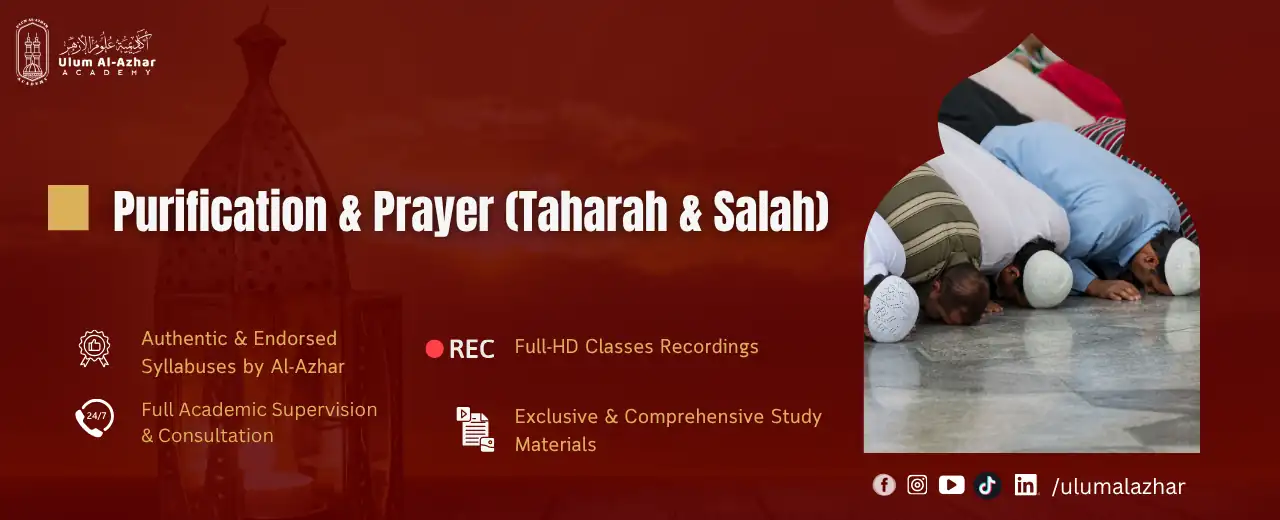
The “Purification and Prayer” course provides a comprehensive guide to the essential practices of Taharah and Salah, including Wudu, Ghusl, and Tayammum. As well as the rules for leading prayers, special prayers, and funeral rites.
Conclusion
Due to the importance of night prayer in a Muslim’s life, and its profound effect on the righteousness of the heart, the uprightness of one’s religion, and the stability of one’s faith, it was initially made obligatory in the early days of Islam.
The Companions (رضي الله عنهم) used to stand in prayer until their feet became swollen from long standing in devotion. Then Allah, Most High, lightened the burden for the Muslims by lifting its obligation while preserving its great virtue and reward.
Learning how to prayer tahajjud does not require complexity. It requires sincerity, consistency, and love for Allah. Even two rak‘ahs prayed regularly with humility are more powerful than long prayers without consistency.
Unlock your Islamic learning journey, starting with free consultation alongside Al-Azhar-certified Sheikhs in Egypt.
FAQ
What is the minimum prayer for Tahajjud?
The minimum is two rak‘ahs after sleeping at night.
Do I have to pray Tahajjud every night?
No, it is voluntary. Consistency is recommended but not obligatory.
Is Witr necessary after Tahajjud?
It is recommended to end the night prayer with Witr.
Can I pray Tahajjud alone?
Yes. Tahajjud is primarily an individual prayer.
Does Tahajjud require long Qur’an recitation?
No. Any surah is valid. Length is optional.
Why is learning how to prayer tahajjud important?
Because it builds faith, strengthens the heart, purifies the soul, and creates a deep connection with Allah.
