How Many Rakats in Zuhr? Complete Prayer Guide
Table of Contents
Islam has greatly exalted the status of prayer, elevated its mention, and raised its rank. It is the greatest pillar of Islam after the two testimonies of faith. Prayer is the first matter for which a servant will be held accountable on the Day of Judgment. The Prophet ﷺ said: “The first deed for which a servant will be brought to account on the Day of Resurrection is the prayer. If it is sound, then the rest of his deeds will be sound; and if it is corrupt, then the rest of his deeds will be corrupt.
Among the five daily prayers, Zuhr holds a special place as it is performed in the middle of the day, offering a spiritual pause amidst worldly responsibilities. Many Muslims—especially new learners and those living in Canada and other Western countries—often ask: how many rakats in Zuhr and how to perform them correctly.
This comprehensive guide will answer that question in detail while also explaining the structure, significance, and proper way to perform Zuhr prayer.
Begin your unique Islamic learning path with a free consultation led by Al-Azhar-certified Sheikhs from Egypt.

How Many Rakats in Zuhr and How They Are Divided
The obligatory prayers are five in the day and night, and the second of them is Zuhr prayer. The word “Zuhr” is derived from “ẓuhūr” (appearance), as it occurs clearly in the middle of the day. Linguistically, “Zuhr” refers to the time after the sun passes its zenith, while in Islamic terminology it is the name of the prayer, derived from the time in which it is performed.
The question how many rakats in Zuhr is one of the most frequently asked by Muslims seeking clarity in their worship. Zuhr prayer consists of four obligatory (fard) rakats, but when including the recommended Sunnah prayers, the total becomes ten rakats.
Here is the breakdown:
- 4 Sunnah (before the fard)
- 4 Fard (obligatory)
- 2 Sunnah (after the fard)
The full number is typically 10 rakats but when someone asks how many rakats in Zuhr, the answer is only 4 are strictly obligatory.
The Sunnah rakats are highly recommended and were consistently observed. They serve as a means to gain extra reward and compensate for any (deficiency) in the obligatory prayer.
Sunnah and Fard Prayers in Zuhr Explained
To better understand how many rakats in Zuhr, it is important to distinguish between Sunnah and Fard prayers.
1. Fard (Obligatory) Rakats
The four fard rakats are mandatory. Missing them without a valid excuse is sinful, and the Muslim must make it up immediately whether it is missed with an excuse or without an excuse.
2. Sunnah Rakats
It was reported from Ibn ʿUmar رضي الله عنه that he said:
“I memorized from the Prophet ﷺ ten rak‘ahs: two rak‘ahs before Zuhr, two after it, two after Maghrib in his house, two after ʿIsha in his house, and two before Fajr.”
And it was reported from ʿAisha رضي الله عنها that the Prophet ﷺ never left four rak‘ahs before Zuhr and two rak‘ahs before Fajr. [Narrated by al-Bukhari].
There is no contradiction between this hadith and the narration of Ibn ʿUmar in which he mentioned two rak‘ahs before Zuhr, because this is additional knowledge that ʿAisha رضي الله عنها was aware of, while Ibn ʿUmar رضي الله عنه was not.
Step-by-Step Way to Perform Zuhr Prayer
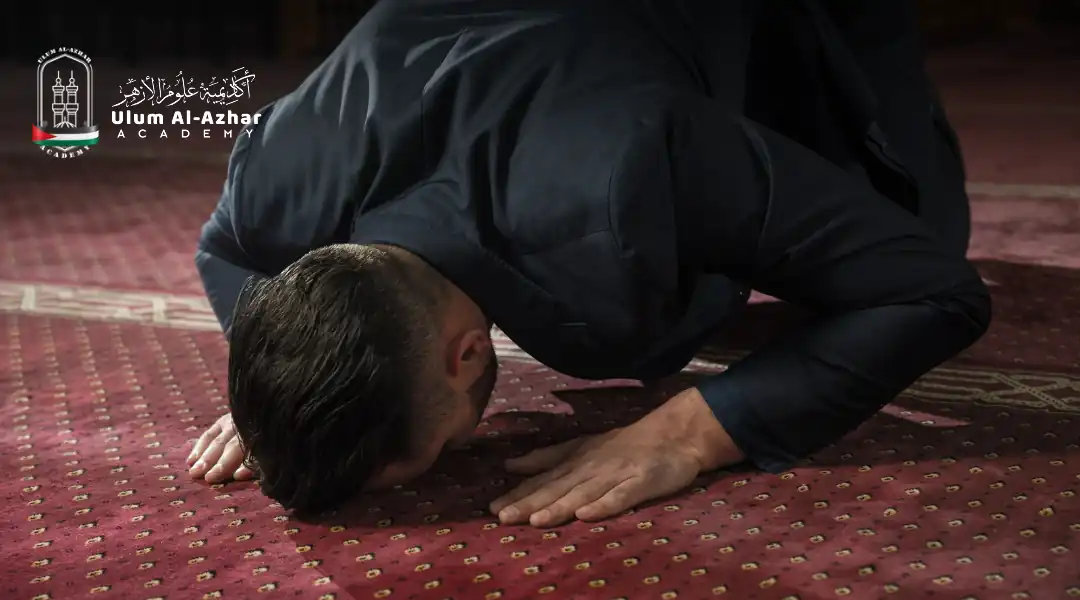
Zuhr prayer is a silent prayer. Understanding how many rakats in Zuhr is only the first step; knowing how to perform them correctly is equally important. Below is a simplified step-by-step guide shows How to Perform Zuhr Prayer
- Intention (Niyyah) Make the intention in your heart for the specific prayer
- Performing ablution (wudu) and ensuring the purity of the body, clothes, and place of prayer.
- Making sure that the time for prayer has begun, indicated by the call to the Zuhr adhan.
- Facing the Qiblah.
- Making the intention in the heart to perform Zuhr prayer.
- Saying the opening Takbir (“Allahu Akbar”).
- Seeking refuge in Allah from Satan (“أعوذ بالله من الشيطان الرجيم”).
- Reciting Surah Al-Fatiha.
- Reciting what is easy from the Qur’an from memory.
- Bowing (ruku‘) while saying “Allahu Akbar,” keeping the back straight and placing the hands on the knees.
- Glorifying Allah in ruku‘ by saying “Subhana Rabbiyal ‘Adheem,” preferably three times.
- Rising from ruku‘ saying “Sami‘a Allahu liman hamidah” .
- Standing upright and saying “Rabbana wa laka al-hamd.”
- Saying “Allahu Akbar” and going down to prostration (sujud), placing seven parts on the ground: the forehead with the nose, both knees, both palms, and the toes of both feet.
- Glorifying Allah in sujud by saying “Subhana Rabbiyal A‘la,” preferably three times.
- Rising from sujud saying “Allahu Akbar.”
- Sitting between the two prostrations and saying: “Rabbi ighfir li, warhamni, wa ‘afini, warzuqni, wahdini, wajburni.”
- Performing the second prostration like the first.
- Rising from the second prostration saying “Allahu Akbar.”
- Performing the second rak‘ah in the same way as the first.
- Sitting for Tashahhud after the second prostration of the second rak‘ah.
- Reciting the Tashahhud:
“At-tahiyyatu lillahi was-salawatu wat-tayyibat, as-salamu ‘alayka ayyuhan-nabiyyu wa rahmatullahi wa barakatuh, as-salamu ‘alayna wa ‘ala ‘ibadillahis-salihin, ash-hadu an la ilaha illa Allah, wa ash-hadu anna Muhammadan ‘abduhu wa rasuluh.” - Standing up after Tashahhud to perform the third and fourth rak‘ahs.
- Performing the third and fourth rak‘ahs like the previous ones, except that only Surah Al-Fatiha is recited.
- Sitting after the second prostration of the fourth rak‘ah for the final Tashahhud.
- Reciting the Tashahhud again, followed by the Ibrahimic prayer:
“Allahumma salli ‘ala Muhammad wa ‘ala ali Muhammad, kama sallayta ‘ala ali Ibrahim, innaka hamidun majid. Allahumma barik ‘ala Muhammad wa ‘ala ali Muhammad, kama barakta ‘ala ali Ibrahim, innaka hamidun majid,” then making any supplication. - Ending the prayer by turning the head to the right and left, saying: “As-salamu ‘alaykum wa rahmatullah” on each side.
Common Mistakes in Zuhr Prayer
It was narrated from Abu Hurairah رضي الله عنه that the Prophet ﷺ said:
“Do you see if there were a river at the door of one of you in which he bathed five times a day, would any dirt remain on him?”
They said, “No dirt would remain on him.”
He said, “That is the example of the five daily prayers; Allah erases sins through them.”
Even those who know how many rakats in Zuhr may unknowingly make mistakes that affect the quality of their prayer. Here are some common errors:
– Among the mistakes that some people make is pronouncing the intention aloud when beginning the prayer, such as saying: “I intend to pray Zuhr…” whereas the intention is (in the heart) محلها القلب.
– Another mistake is not ensuring the correct time for prayer; the correct time for Zuhr begins after the sun has passed its zenith, not at the exact moment of zenith itself.
– Among the common mistakes many people fall into is being careless about performing the five daily prayers at their proper times in congregation at the mosque, despite the great virtue and strong encouragement for congregational prayer found in the Qur’an and Sunnah. Allah, the Exalted, says:
“Maintain with care the [obligatory] prayers and [in particular] the middle prayer, and stand before Allah in devotion.” (Al-Baqarah: 238)
Daily Prayer Guidance for Muslims in the West
It was narrated from Abu Hurairah رضي الله عنه that the Messenger of Allah ﷺ said:
“Shall I not guide you to that by which Allah erases sins and raises ranks?”
They said, “Yes, O Messenger of Allah.”
He said, “Perfecting wudu even in difficulty, taking many steps to the mosques, and waiting for one prayer after another……….”
For Muslims living in Western countries, maintaining daily prayers like Zuhr can be challenging due to work schedules, school, or social environments. Still, knowing how many rakats in Zuhr and prioritizing them is essential.
Understanding the essential aspects of Islamic purification (Taharah) and prayer practices under the supervision of qualified teachers from Al-Azhar Al-Shariff, Egypt.
Conclusion
It was narrated from Abu Hurairah رضي الله عنه that the Prophet ﷺ said:
“Do you see if there were a river at the door of one of you in which he bathed five times a day, would any impurity remain on him?”
They said, “No impurity would remain on him.”
He said, “That is the example of the five daily prayers; Allah wipes away sins through them.”
To summarize, the answer to how many rakats in Zuhr is clear and consistent: four obligatory rakats, supported by six Sunnah rakats, making a total of ten for those who wish to follow the complete practice.
Zuhr prayer is more than a routine—it is a moment of reflection, discipline, and connection with Allah. By understanding its structure, avoiding common mistakes, and maintaining consistency, every Muslim can elevate the quality of their worship.
For personalized Islamic learning, get a free consultation session with Al-Azhar-certified Sheikhs based in Egypt.
FAQs
1. How many rakats in Zuhr are obligatory?
There are 4 obligatory (fard) rakats in Zuhr prayer.
2. How many rakats in Zuhr including Sunnah?
There are 10 rakats in total: 4 Sunnah before, 4 Fard, and 2 Sunnah after.
3. Can I skip Sunnah rakats?
Yes, Sunnah rakats are not obligatory, but they are highly recommended and should not be neglected regularly.
4. Is Zuhr prayer silent or loud?
Zuhr prayer is recited silently, unlike Fajr, Maghrib, and Isha.
