
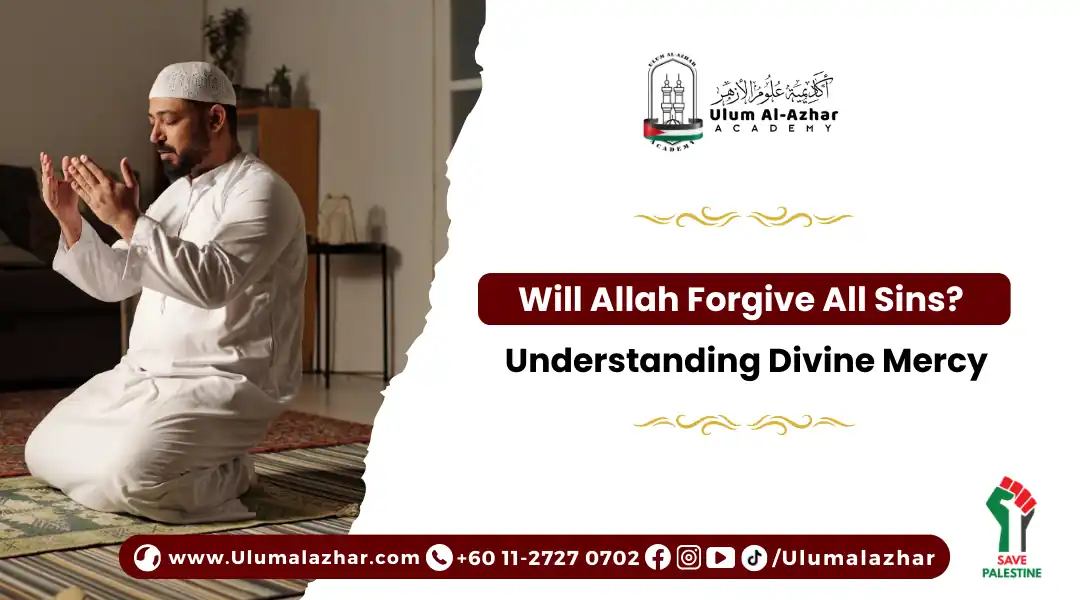
Will Allah Forgive All Sins? Understanding Divine Mercy
Table of Contents
An elderly man came to the Prophet ﷺ, his eyebrows had fallen over his eyes because of old age, and he was leaning on a staff. He said: “O Muhammad, I have sins that, if they were distributed among the people of the earth, they would destroy them. Is there any repentance for me?” The Prophet ﷺ replied:
“Do you bear witness that there is no god but Allah and that I am the Messenger of Allah?”
He said: “I bear witness that there is no god but Allah and that you are the Messenger of Allah.” The Prophet ﷺ then said: “Then Allah will replace them for you with good deeds.” The man said: “Even my betrayals and my immoral acts?” He ﷺ said: “He will replace them with good deeds.” So the man turned away saying: “Allahu Akbar, Allahu Akbar.”
This story can answer the question will allah forgive all sins? At the heart of Islamic belief is the understanding that Allah is not merely a Judge, but also the Most Merciful, the Most Compassionate, the One whose mercy surpasses His wrath. Divine forgiveness is not limited, conditional upon perfection, or restricted to certain categories of people. Rather, forgiveness is a door that remains open as long as life remains.
We will explore the question will allah forgive all sins through the Quran, the Sunnah, spiritual wisdom, and authentic Islamic teachings, offering clarity, balance, and hope for every soul seeking closeness to Allah.

Understanding the Meaning of will allah forgive all sins
Allah تعالى says: “Say, O My servants who have transgressed against themselves: Do not despair of the mercy of Allah. Indeed, Allah forgives all sins. Indeed, He is the Most Forgiving, the Most Merciful.”
(Surah Az-Zumar, 53)
This verse indicates the perfection of Allah’s mercy, His grace, and His إحسان divine kindness toward His servants. So,to understand the question will allah forgive all sins, one must first understand the nature of Allah in Islamic belief. Allah is Al-Rahman (The Universally Merciful) and Al-Raheem (The Especially Merciful). Mercy is not a secondary attribute—it is central to His divine identity.
Is there any contradiction between the previous verse and the statement of Allah, the Exalted:
“Indeed, Allah does not forgive associating partners with Him, but He forgives what is less than that for whom He wills. And whoever associates others with Allah has certainly fabricated a great sin.” (Surah An-Nisa 48)
The answer is: No.
Because this is a decisive (clear and definitive) verse revealed concerning the people of shirk (polytheism) if they die while upon shirk. If a person dies as a polytheist, Allah does not forgive him. But if he embraces Islam and repents to Allah, then Allah forgives him.
The meaning of will allah forgive all sins is not a question of Allah’s ability, but a question of human sincerity. Allah’s mercy is unlimited; human repentance is the condition. No matter how great the sin, divine mercy is greater.
Initiate your bespoke Islamic learning experience with a free consultation, guided by Al-Azhar-certified Sheikhs from Egypt.
Conditions for True Repentance in Islam
When asking will allah forgive all sins, Islam gives a clear and structured answer through the concept of tawbah (repentance).
Allah’s mercy is vast, and among the manifestations of His vast mercy is that He forgives all sins, no matter how great they are, for whoever repents from them and turns back to Him. It is authentically reported in the two Sahihs (Al-Bukhari and Muslim) that the Prophet ﷺ said:
“Allah is more joyful over the repentance of His servant than one of you who finds his lost camel in a barren desert after losing it…”
Learn about the types of sins in Islam and the difference between major and minor sins.
If the sin committed by a Muslim is between him and Allah alone, and does not involve the rights of other people, then he must repent to Allah with a true repentance through the following conditions:
- Sincerity (Ikhlāṣ): That his repentance is purely for the sake of Allah, the Almighty.
- Abandoning the sin: To immediately stop committing it.
- Remorse: To feel genuine regret for what he has done.
- Firm resolve: To be determined never to return to it again.
- Timing of repentance: That the repentance takes place before the soul reaches the throat at the moment of death (i.e., before the agony of death begins).
Allah تعالى says:
“And those who do not invoke another god along with Allah, nor kill the soul which Allah has forbidden except by right, nor commit adultery—and whoever does that shall meet a penalty.
The punishment will be multiplied for him on the Day of Resurrection, and he will remain in it humiliated.
Except for those who repent, believe, and do righteous deeds—for them Allah will replace their evil deeds with good deeds. And Allah is Ever Forgiving, Most Merciful.”
(Surah Al-Furqan 68–70)
The Messenger of Allah ﷺ said in an authentic hadith narrated by Abu Bakr رضي الله عنه:
“There is no person who commits a sin, then rises, performs purification (wudu’), and prays two (units of prayer) in which he does not distract himself, except that Allah will forgive his sin.”
But if the sin involves the rights of another human being, then in addition to fulfilling the previous conditions, the Muslim must free himself from the right of the person he wronged. If they take their right from him, or forgive him, then he has truly repented to Allah and becomes purified through that repentance—whatever the sin may have been—because Allah replaces sins with good deeds.
This is one of the fundamental differences between Islam and Christianity: in Christianity, a person is given the green light to do whatever they want, and in the end, they simply confess and are forgiven without regard for the rights of other people. In Islam, however, this is not the case.
Quranic Verses That Emphasize Allah’s Mercy
The Quran directly answers the question will allah forgive all sins with clarity, power, and compassion.
Allah the Exalted has commanded His servants to repent, return to Him, and constantly turn back to Him. He has clarified His love for those who repent, the virtue of repentance, and many matters related to repentance in numerous Quranic verses, including:
“Except for those who repent, reform, and make things clear—those I will accept their repentance, and I am the Accepting of Repentance, the Most Merciful.”
(Surah Al-Baqarah, 160)“Except for those who repent after that and reform—then indeed Allah is Forgiving, Merciful.
Indeed, those who disbelieve after their belief and then increase in disbelief—never will their repentance be accepted, and those are the misguided.”
(Surah Aal ‘Imran, 89–90)“And those who, when they commit an immorality or wrong themselves, remember Allah and seek forgiveness for their sins—and who can forgive sins except Allah?—and they do not persist in what they have done while they know.”
(Surah Aal ‘Imran, 3:135)“So whoever repents after his wrongdoing and reforms, indeed Allah will turn to him in forgiveness. Indeed, Allah is Forgiving, Most Merciful.”
(Surah Al-Ma’idah, 5:39)“And when those who believe in Our verses come to you, say, ‘Peace be upon you.’ Your Lord has decreed mercy upon Himself: that whoever among you does wrong in ignorance, then repents after that and reforms—indeed, He is Forgiving, Merciful.”
(Surah Al-An‘am, 6:54)“And seek forgiveness of your Lord, then repent to Him. He will grant you good provision for an appointed term and give every possessor of virtue his due. But if you turn away, then indeed I fear for you the punishment of a great Day.”
(Surah Hud, 11:3)“Then indeed your Lord, to those who committed evil in ignorance, then repented after that and reformed—indeed, your Lord after that is Forgiving, Merciful.”
(Surah An-Nahl, 16:119)
Ready for personalized Quranic learning? choose now from the best Quran & Qiraat Studies courses with our Al-Azhar-certified Sheikhs in Egypt.
Stories from the Sunnah About Forgiveness and Hope
The Sunnah provides living examples of divine mercy in action. The Prophet ﷺ taught forgiveness not as theory, but as lived reality.
Narrated Abu Sa‘id رضي الله عنه that the Messenger of Allah ﷺ said:
“Among those who came before you was a man who killed ninety-nine people. He asked about the most knowledgeable person on earth, and he was directed to a monk. He went to him and said:
‘I have killed ninety-nine people. Is there any repentance for me?’
He said: ‘No.’
So he killed him, completing one hundred.
Then he again asked about the most knowledgeable person on earth, and he was directed to a scholar. He came to him and said:
‘I have killed one hundred people. Is there any repentance for me?’
He said: ‘Yes. And who can stand between you and repentance? Go to such-and-such a land, for there are people there who worship Allah. Worship Allah with them, and do not return to your land, for it is an evil land.’
So he set out, and when he reached halfway along the path, death came to him. The angels of mercy and the angels of punishment disputed over him.
The angels of mercy said: ‘He came repentant, turning with his heart toward Allah.’
The angels of punishment said: ‘He never did any good at all.’
Then an angel came to them in the form of a human being, and they made him an arbitrator between them. He said:
‘Measure the distance between the two lands. Whichever he is closer to, he belongs to.’
They measured, and found that he was closer to the land he intended to go to.
So the angels of mercy took his soul.”
This hadith is one of the strongest proofs of Allah’s limitless mercy, the power of sincere repentance, and the (greatness) of divine compassion—even for the greatest of sinners who turn back to Allah with a truthful heart.
These stories directly answer the question will allah forgive all sins by showing that forgiveness is not limited by quantity, severity, or repetition—but by sincerity.
Know Your Prophet (Attributes & Seerah of Prophet Muhammad PBUH) through Seerah of Prophet Muhammad: studying his life, character, attributes, and teaching style.
How to Strengthen Faith After Sin
Among the things that help a person stay away from sins are: keeping the company of the righteous, remaining close to people of goodness, and avoiding the companionship of those whose company brings about sins and evils. Allah تعالى says:
“And keep yourself patient with those who call upon their Lord morning and evening, seeking His Face. And do not let your eyes pass beyond them, desiring the adornment of worldly life. And do not obey one whose heart We have made heedless of Our remembrance, who follows his own desires, and whose affair is in ruin.”
(Surah Al-Kahf, 28)
And among the things that help in performing acts of obedience and avoiding sins and evils are: frequently attending gatherings of remembrance (ḥalaqāt al-dhikr) and circles of knowledge, for this increases faith and strengthens the inner moral restraint within a person, driving him toward righteousness and keeping him away from wrongdoing.
Also, reflecting on death and what comes after it of great terrors and momentous matters, remembering that the appointed time (death) is hidden from the servant, and that death may come suddenly without warning or expectation—along with being conscious of Allah’s constant watchfulness over His servants, that He is fully aware of them, encompassing them, and that nothing of their affairs is hidden from Him.
The believer who understands will allah forgive all sins does not see sin as an ending, but as a turning point toward spiritual growth.
Ulum Al-Azhar Academy’s Guidance on Repentance
Repentance is taught as a lifelong process of purification, not a one-time event. The human soul is in constant need of renewal, correction, and spiritual return.
True repentance is not driven by terror alone, nor by false hope alone. It is driven by love of Allah, respect for divine guidance, and awareness of accountability.
This guidance reinforces that the answer to will allah forgive all sins lies in sincerity, humility, and continuous return to Allah.
Curate your Islamic studies learning journey: schedule your course with Al-Azhar-certified Sheikhs from Egypt.
Conclusion
The question will allah forgive all sins is not a theological puzzle—it is a spiritual lifeline. Islam does not present a God who waits to punish, but a Lord who invites His servants to return, again and again.
Allah’s mercy is greater than every sin, deeper than every fall, and stronger than every weakness. No matter how far a person feels, the path back to Allah is always open.
So the answer is clear: Yes—Allah forgives all sins for those who return to Him with sincere hearts.
A free consultation with Al-Azhar-certified Sheikhs from Egypt is your gateway to personalized Islamic learning.
FAQs
Will Allah forgive all sins even major sins?
Yes. Major sins are forgiven through sincere repentance.
Will Allah forgive all sins if they are repeated?
Yes, if repentance is sincere each time and the heart truly seeks change.
Will Allah forgive all sins if someone feels unworthy?
Forgiveness is based on Allah’s mercy, not human worthiness.
What if someone sins again after repentance?
They repent again. Allah’s door remains open.
